

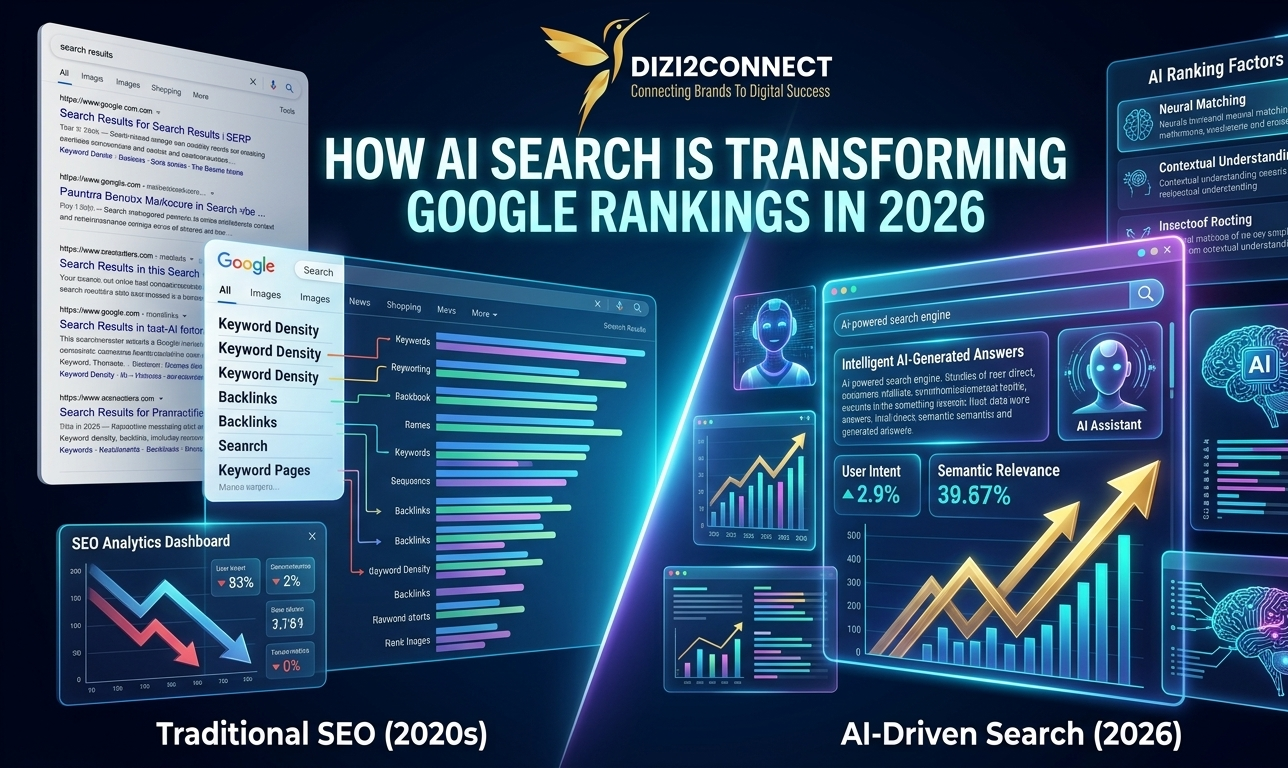
If you have been watching your website traffic slide month after month while your rankings sit untouched, something bigger is going on. Most business owners notice the drop but never connect it to what is actually happening inside Google. The truth is, search has changed more in the last two years than it did in the previous ten, and the businesses that figure this out early will have a serious edge over those that don’t. this guide will help you understand How AI Search Is Transforming Google Rankings in 2026.
The rise of AI search is changing how people find information on the internet. Google’s AI Overviews now answer queries right on the results page before a user clicks a single link. If your business has been depending on organic traffic to bring in leads and customers, now is the time to pay close attention. This blog explains exactly how AI search is changing Google rankings in 2026, what the data says, and what actionable steps you should take to stay visible and competitive.
What AI Search Means for Google Search Results?
But before you can adapt, you need to know what has changed, in fact. Google’s AI Overviews are AI-generated summary panels that show up right at the top of search results. They take information from a lot of websites and give a combined answer right away so the user doesn’t have to scroll or click to find what they need.
- AI Overviews are powered by Google’s Gemini AI model.
- They are often the most common for informational queries.
- They push down traditional organic results on the page, often below the fold.
- As of early 2026, AI Overviews appear in roughly one in four all US searches, a number that continues to climb.
Think about what this actually means for your content. A blog post that used to pull in hundreds of visitors every month is now competing with an AI-generated answer sitting right at the top of the page. If your content strategy was built around capturing informational traffic, things have shifted in a big way, and waiting any longer to respond will only cost you more ground.
The Zero-Click Reality: The Numbers Have It All To Say
The data underlying AI search is eye-opening, and every marketer and business owner needs to sit with it. This is not a small change. This is a fundamental change in the way people search and interact with results.
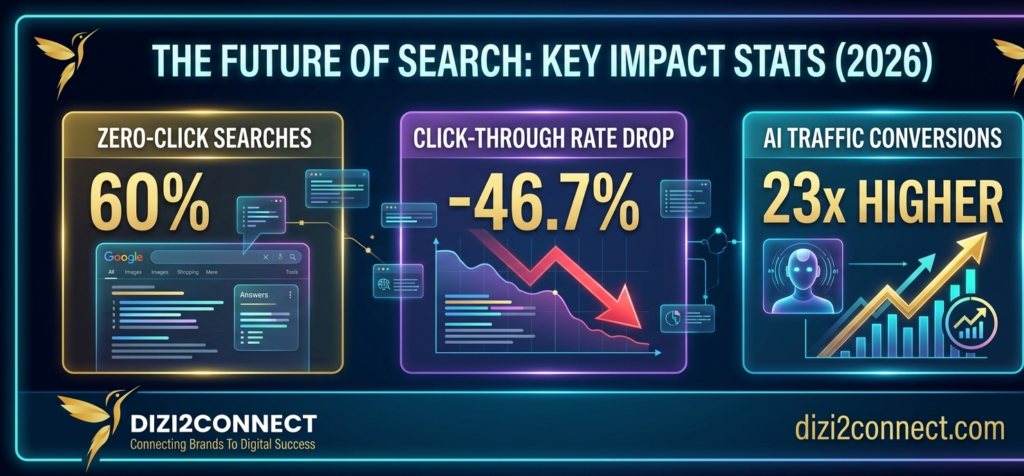
- Today, thanks to AI-generated summaries, about 60% of all searches end without a click.
- According to Pew Research Center, the click rate dropped by 46.7% when AI overviews were present, with CTR falling from 15% to 8%.
- The volume of AI-referred traffic is lower but converts at 23x higher rates than traditional organic traffic.
- Citations from top-10 ranked pages in AI Overviews have fallen from 76% to a mere 38%, so being on page one no longer guarantees you will be cited in AI responses.
The final stat is perhaps the most alarming for many businesses. You can still be in position one and miss out entirely on the AI Overview, which is what most users see first. A good ranking is still important, but it’s not enough anymore. The new goal is to be considered citation-worthy by AI systems.
How AI Search Is Changing the Rules of SEO?
So what does all this mean for your future approach to SEO? The old days of SEO were keyword targeting, backlink building and getting to page one. That foundation is still important, but the strategy built on top of it has to change quite a bit.
Here’s what’s different about Google’s AI way of evaluating and ranking content:
- It’s less about keywords, more about intent: AI systems understand what you mean rather than the words you use. Content must be built around actual questions and complete answers.
- Structured content wins: AI citations are much higher for comparison pages with tables and shortlist formats than long-form articles.
- Brand authority is more crucial than ever: Branded web mentions now correlate more strongly with AI Overview appearances than traditional backlinks.
- E-E-A-T is non-negotiable: Google’s AI systems are heavily biased towards content demonstrating real experience, expertise, authority and trust.
- Freshness matters: AI models prefer fresh content, so publishing on a regular basis is more important than ever.
To appear in AI Overviews and in answers in AI Mode, your brand must be formatted as answers, not simply articles. Imagine each major heading as an answer to a question your ideal customer would ask.
To stay ahead of these algorithm shifts, investing in professional SEO services that consider AI-first ranking factors is a smart, timely place to start.
Generative Engine Optimization: The New Domain of SEO

Perhaps you are hearing the term GEO more frequently. Generative Engine Optimisation is the process of optimising your content for both Google’s traditional algorithm and specifically for how AI systems extract and cite information. By 2026 it will very quickly become a vital part of any serious digital marketing strategy.
That is what GEO is all about:
- Writing content in straightforward, simple Q&A formats that make it easy for AI to extract and surface.
- Schema markup to assist search engines and AI systems in properly understanding the structure of your content.
- Developing new research, data or case studies that are more likely to be cited by AI systems than general content.
- Building a brand presence on YouTube, forums, review sites and social media.
- Optimising content structure and entity relationships for both AI citations and traditional rankings.
GEO-investing companies are already reporting 300 to 500% ROI within 6 to 12 months, with content optimised for GEO seeing a 30 to 40% increase in visibility across AI search results. These numbers make it very clear that companies building this capability today are getting a huge head start over companies that are not.
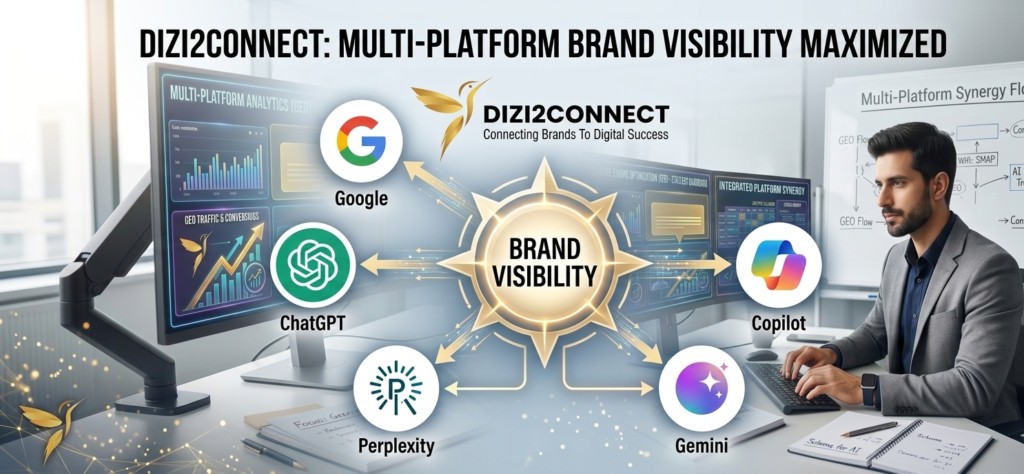
Dizi2Connect is already helping brands rank and perform across platforms such as Google, ChatGPT, Perplexity, Gemini and Copilot. This creates the perfect opportunity to look at a multi-platform digital marketing strategy over a Google-only approach.
What Businesses Should Do Now to Adapt?
The winners won’t be the companies that are panicking about AI. They’re the ones who will be making smart, calculated adjustments to their strategy early on. Here is a real-life action plan that you can begin to use right now.
Audit Your Top Pages for AI Risk
- Identify pages most likely to trigger AI overviews for informational queries.
- Take a look at the structure of those pages and see if they are built to provide a direct, clear answer near the top.
- Update page structures so that the most important information is in the first 100 words.
Enhance Your Content Architecture
- Use headlines that mirror real questions your audience is asking.
- Add comparison tables, numbered lists and bullet points that AI systems can extract well.
- Add in specific data points and original ideas that generic AI answers just can’t replicate.
Establish Brand Authority Across the Web
- Obtain third-party website mentions, review sites, and trade publications.
- Brand authority and third-party validation via PR and mentions are important signals for inclusion in AI-driven search.
- Be active on YouTube and community platforms, as YouTube and Reddit comprise over 78% of AI social media citations.
Track Additional Metrics Besides Traditional Rankings
- See traffic coming from ChatGPT, Perplexity, and Gemini right in your analytics dashboard.
- Track AI citation frequency, not just search position.
- Track brand impressions across non-click sessions as well.
Lay Your Technical SEO Groundwork
- Use structured data and schema markup for your core pages.
- Ensure fast page load times, as there is a direct correlation between site speed and AI citation rates.
- Ensure your website is free of crawling or indexing issues that would prevent AI systems from accessing your content.
If businesses want a full audit of how their current strategy stacks up against AI-first ranking factors, Dizi2Connect’s digital marketing services include everything from technical SEO to content strategy and performance tracking.
Is Old-School SEO Dead? The Truth Is Near
This question is popping up everywhere right now, and the honest answer is no. Traditional SEO isn’t dead. It has become something larger and more demanding.
AI citation is still propped up by high rankings. Expert, original, well-structured content simultaneously gets both traditional rankings and AI citations. Consistent publishing and third-party mentions establish brand authority over time in ways no algorithm change can fully undo.
Businesses that throw SEO under the bus altogether with AI search will lose on both fronts. Running away from SEO because AI search is trending is not a strategy; it is a gamble that most businesses simply cannot afford. The wiser path is to see traditional SEO and AI-first optimisation as two parts of the same bigger picture, working together rather than against each other. According to Gartner, as much as 25% of organic search traffic will migrate to AI chatbots and voice assistants by the end of 2026. That still leaves three quarters of search behaviour running through more familiar channels, which means pulling back on SEO right now would be a decision you would likely regret. The real opportunity lies in creating content and building authority that performs well in both environments, and with the right approach, that is very much within reach.
Conclusion
AI search is not a future trend anymore. The reality of the day is how your business gets found online today. The move to AI Overviews, zero-click searches and generative engine optimisation has changed the game for what it takes to earn visibility on Google rankings in 2026.
Brands that make these adaptations now, structuring content for AI citations, building real authority, and tracking new visibility metrics, are going to have a massive competitive edge over brands still deploying strategies from three years ago. If you’re not sure where your current strategy fits into this new landscape, the most important first step you can take is a professional audit. Talk to the Dizi2Connect team to find out how a future-proof SEO and digital marketing strategy can safeguard and grow your visibility in the age of AI search.
Frequently Asked Questions
What is AI search, and how is it different from Google Search?
Artificial intelligence models like Google’s Gemini are used by AI search to generate direct answers at the top of search results. Old-school search gives you a list of links. AI search synthesises information from multiple sites so the user often gets the answer without clicking through to any website.
Why have my Google rankings stayed the same but traffic dropped?
This is a common consequence of AI overviews. When AI is generating a summary for your target query, users read the answer and leave without clicking. Thus, your ranking remains intact, but your click-through rate drops significantly.
What is zero-click search and why should you care?
When someone types a query into Google and gets their answer right there on the results page without visiting any website, that is a ‘zero-click’ search. It is becoming far more common because of AI overviews, which means businesses need to shift focus toward brand visibility and earning AI citations rather than chasing clicks alone.
What is Generative Engine Optimisation (GEO)?
GEO is the optimisation of your content specifically for extraction and citation by AI-powered search tools such as Google AI Overviews, ChatGPT and Perplexity. It’s about structure of content, clarity, originality and brand authority, not just keywords.
Traditional SEO in 2026: Is it still relevant?
Yes, definitely. Getting cited in AI Overviews still comes down to old-school SEO. Good rankings, quality backlinks and well-structured content still matter. The thing is that now you have to add AI-first optimisation on top of your existing SEO efforts.
How can a digital marketing agency help with AI search optimisation?
Picture this. Your top landing pages are quietly losing clicks every week. An experienced digital marketing agency spots exactly where AI overviews are eating into your visibility, rebuilds your content so it is structured for citation, gets your schema markup in place, and tracks every referral coming in from ChatGPT, Gemini, and Perplexity. That is the difference between reacting too late and staying ahead of the curve.
Tags: