

Digital marketing is a term that is ubiquitous in the hyper-connected world. But what is it really and why has it become such a key ingredient to companies of all sizes? In a easy and exciting manner, this guide will make you understand the basics, significance, and future of digital marketing.
What is digital marketing?
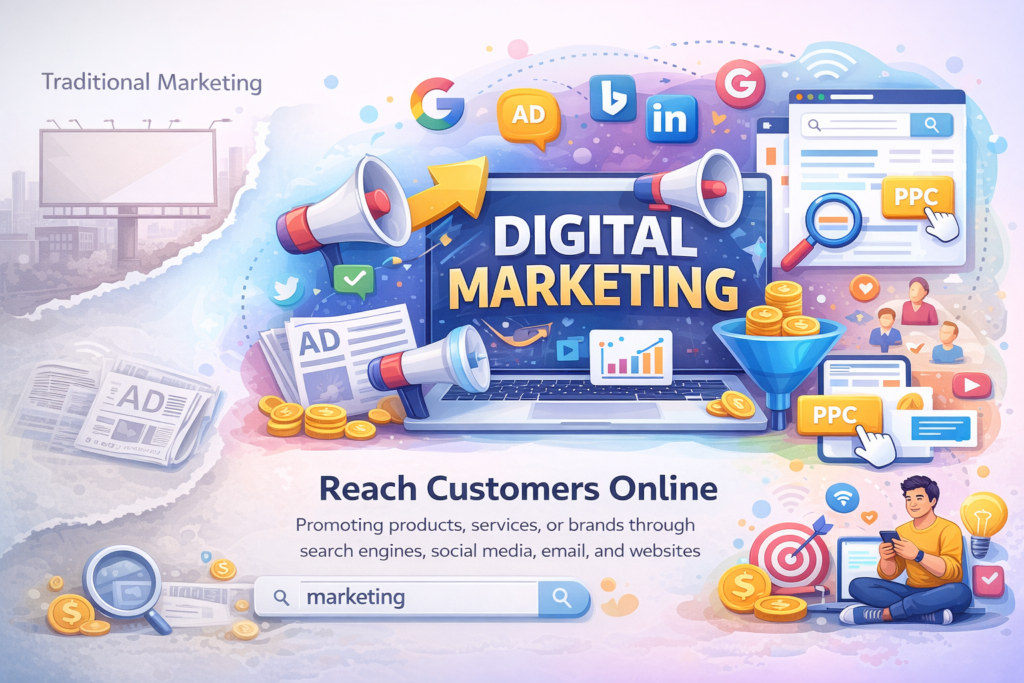
Let’s start with the basics. The easy yet effective process of marketing products, services or brands through the online mediums is digital marketing. Develop it is just the modern version of conventional marketing. It does not use billboards or advertising in newspapers, but instead uses online platforms such as search engines (Google, Bing), social media (Facebook, Instagram, LinkedIn), email, and Web sites to reach its current and potential customers where they devote a lot of their time: online.
Difference between Traditional and Digital Marketing
Although both aim to reach customers and drive sales, their approaches differ drastically, representing two completely opposite strategies in practice. On major parameters, we might compare them as follows:
Price: The expense of traditional marketing such as prime-time television advertisement involves huge productions and airtime expenses. Digital marketing is easier to start, requiring a lower budget and offering precise control over spending, like targeted Google Ads campaigns.
Reach: A billboard has a definite, geographical reach. Digital marketing eliminates these barriers such that a small business in Delhi may easily reach its potential customer in New York.
Measurability: What is the correct way of measuring the number of people who saw a newspaper advertisement? It’s nearly impossible. Digital marketing on the other hand is very measurable. With technologies, such as Google Analytics, you can monitor clicks, conversions, engagement or ROI in real time.
Participation: Traditional marketing is a one-way (brand to consumer) affair. Digital marketing is a two way communication, where brands get to engage with the audience in terms of comments, messages and shares.
Targeting: The advertisement on TV is broadcasted to all people no matter whether they are interested or not. Through digital marketing, hyper-specific targeting is possible which is usually done according to demographics, interests, online behavior and even life events.
Father of Digital Marketing
The digital marketing has number of pioneers who laid down its foundations and provided very important pieces of the jigsaw.
Philip Kotler: Kotler is also dubbed as the Father of Modern Marketing, and his strategic approaches and customer-focused philosophies are the foundational blocks on which all new marketing, including digital, is being done. The reason behind all successful digital campaigns is his teachings on understanding what customers need, and how to create value.
Ray Tomlinson: As the engineer that sent the first email in 1971, Tomlinson actually invented the application, which is now one of the most powerful and popular digital marketing channels in the world. His work became the basis of direct digital communication.
Guglielmo Marconi: May belong to a vastly different century but the work that Marconi did in establishing the wireless radio transmission was a giant leap. He facilitated the idea of a mass, wireless, long-distance communication, which is an essential principle upon which our digitalized (linked) world is built.
Why Digital Marketing is Important?
Neglecting digital marketing is comparable to neglecting the telephone in the 20 th century. Its significance cannot be overestimated:
Brand Awareness: Digital marketing is the most effective way to build and maintain your brand online.It helps businesses stay visible and recognizable to their target audience consistently.
International Appeal: It allows you to reach a global audience without requiring an international budget. Businesses can connect with potential customers across borders easily and efficiently.
Cost-Effectiveness: Digital marketing delivers a high return on investment (ROI) for small and medium businesses.It is more affordable and measurable compared to traditional marketing methods.
Measurable Performance: Every dollar spent can be tracked, and past campaigns can be analyzed. This enables optimization and improved strategy based on accurate performance data.
Real-Time Interaction: Brands can engage with customers instantly, providing support and responding to requests. This interaction fosters community building and strengthens customer relationships.
Fundamentals of Digital Marketing
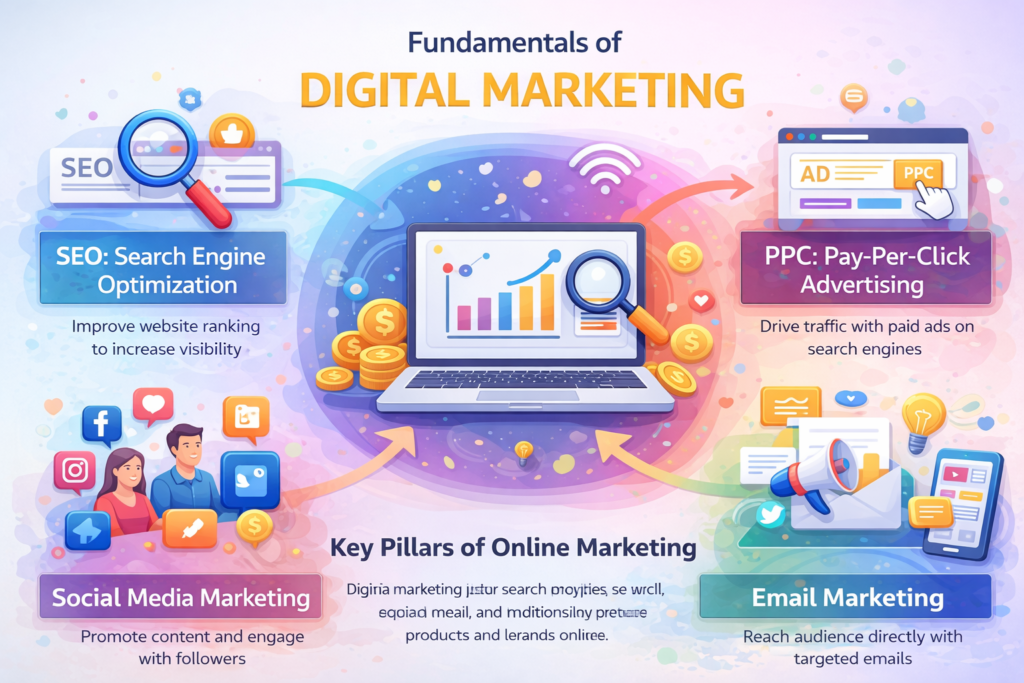
Fundamentals of Digital Marketing are the core principles and channels used to promote products or services online. It involves leveraging digital platforms like search engines, social media, email, and websites to connect with current and prospective customers. The key pillars of Digital Marketing have been discussed here :
SEO Search Engine Optimization
SEO is an art and science of ensuring your web site ranks higher when using a search engine such as Google without paying to be ranked. Imagine using it as a form of talking the language of search algorithms so that they can listen to it and prioritize what you are producing. You get intently driven organic traffic by maximizing on-page details, namely titles, meta tags, headings, and copy voluminous in keywords and generate quality backlinks. It is a long-term investment; the better you are ranked the more credibility and trust you can gain among the users. Also, data mining can be done by the SEO teams to reveal the trends in keywords, which can be useful in future content and product strategies.
SEM (Search Engine Marketing)
SEM is the monetized aspect of the search ladder, and it involves bidding on search keywords in order to be featured in search results on search engine ads such as Google Ads or Bing Ads. SEM provides immediate visibility as opposed to the organic pull of SEO with your ad being placed at the top of the page. It is ideal at launching new campaigns, generating traffic to time-sensitive deals, or targeting individuals not yet aware of you. Pay-per-Click models are cost effective since one only has to pay when someone clicks and so it is a quick-cost means of getting leads or sales. Notable SEM needs a persistent optimization process of bids and ad copy polishing and tracking conversion data to ensure ROI remains high.
Content Marketing
The content marketing is simply about producing and distributing value-added, relevant content that attracts the people to your brand. It may be blogs, eBooks or podcasts, or even infographics but the end goal is to answer, solve or entertain people and ultimately gain trust with your audience. Already rich content nurtures guides loyal customers down the funnel; transforming casual browsers into loyal customers. It drives into other strategies as well: the search engine performance is increased with the help of the articles full of words, the sharing on the posts on social media broadens the scope of the coverage, and the newsletters promote the new articles. The best one is sticking with it- Update often helps remind your audience that you are the first in their minds and you are an authority figure who the search engine will believe interacts and has something to say.
Social Media Marketing
Social media marketing transforms such tools as Facebook, Instagram, LinkedIn, and Tik Tok into an efficient brand stage. You become a two-way conversation with your followers by sharing interesting pictures, short videos and stories, and content you have been curated. This aids in the process of humanizing your brand, increasing community connection and creating word-of-mouth buzz. The reason is that social ads allow becoming highly specific in terms of demographics, interests, or behaviour, and it is simpler to identify niche audiences. Monitoring interest, clicks and conversions on these platforms contributes to your larger marketing strategy, so that you are always perfecting your messaging to give it the best effect.
Email Marketing
Email marketing can be regarded as a direct channel to their inboxes of the most interested prospects and customers. You build relationships and convert by sending personalized and segmented emails, a welcome series or newsletter, or cart-abandonment reminder. It Is the magic of relevance: the more the message can fit the needs or buyer stage of a subscriber, the greater are the open and click rates. A/B testing, automation processes, and dynamic content are some of the tools that enable you to give the appropriate message, at the appropriate time, to your readers to transform a casual reader into a repeated buyer or a promoter of the brand.
Affiliate Marketing
Affiliate marketing is one of the models of partnership whereby you provide commissions to the outside publishers to facilitate sales or leads. Imagine it as a kind of performance-based advertisement strategy: affiliates will is doing the advertising to your products via blogs, podcasts, or social platforms and you will only pay them a reimbursement when they deliver some tangible good. This would provide avenues without necessarily having a big audience in the start up stage. Your affiliates turn out to be brand ambassadors, and you get access to their knowledge and network, which is sometimes in a niche market that would not be readily reached by traditional marketing.
Mobile Marketing
Mobile marketing is concerned with connecting and communicating with consumers on their phones, whether in terms of apps, SMS, push notification or mobile web. Mobile-optimized messaging is essential because a large percentage of the search traffic and e-commerce occurs on phones. SMS can provide highly personal and real-time communication immediately, and the use of app notifications can make users refer to new content or specials. Mobile-first design means that your site will be fast to load, and will appear good on smaller screens. Keep-up with in-app activity and geolocation data to develop context specific campaigns that connect with the user wherever he or she goes.
Video Marketing
Video marketing is an advertising technique relying on dynamic visual narrative, i.e. tutorials on YouTube, Instagram Reels, Tik Tok dances to capture attention and deliver complex concepts within a short period of time. Videos happen to be a great source of product demonstration, customer testimonials, or access to the behind-the-scenes information, since it is already proven to be a fast way to convey information compared to text. Even YouTube is one of the leading search engines, though the short-term attention scope is taken by short-term platforms. Through which titles, thumbnails, and captions are optimized, it is possible to promote a better SEO approach and expansion through numerous channels.
Analytics & Conversions
The roadmap to your digital marketing ship is analytics and conversions. Google Analytics, Hotjar, and marketing dashboard tools can be used to quantify your sources of traffic, user behaviour, and campaign performance. With key measurement, such as bounce rate, duration of the session, funnels conversion, it is possible to figure out what is working and what requires modification. Conversion rate optimization (CRO) is then used to further convert more of these visitors into leads or customers be it with A/B testing landing pages, better calls-to-action, or simplified checkout processes. To briefly put it in, data driven insights would make sure that each dollar of the marketing is used effectively and will result in the optimization of the ROI.
Types of Digital Marketing
Digital marketing is an immense toolbox, however, it is all about realizing the right people at the right time with the use of technology. The search engine optimization (SEO) and content marketing era has ended and the age of pay-per- click advertisements, social media, email campaigns, and indirect partnership with influencers, and programmatic display has begun as per its vibe and target audience.In addition to the main elements, digital marketing may be divided into various strategic options.
Organic vs. Paid Marketing
Organic marketing resembles planting seeds: you spend time and creativity to cultivate the awareness with the help of SEO-friendly material, social media communication, and organic word-of-a-mouth. It is long-term traffic, brand loyalty and a following but needs time and time practiced.
Paid Marketing The accelerator is the paid marketing. Individually, display ads, sponsored posts and retargeting with PPC, you pay to get visibility that will be visible immediately. It is ideal to win fast, whether it is launching, flash sales, or entering new markets but it can be expensive and visibility disappears when you cancel your payments.
Inbound vs. Outbound Marketing
Inbound Marketing: the magnet strategy: you win the prospects with valuable content, problems, get them through the buyer journey through blogs, webinars, SEO and social. It creates trust and develops leads naturally.
Outbound Marketing refers to the door-knocking style. Grant cold emails, TV ads, banner advertisements, and direct mail. You take the initiative and make contact because you want to be seen now but this will usually incur more expenses and lower conversion rate since you are coming in instead of someone inviting you.
Inbound vs. outbound is the distinction between asking to be welcomed into warm social talk and knocking on doors- both have their role to play in cultivating the trust or providing urgency.
B2B vs. B2C Strategies
B2B Strategies Business-to-business (B2B) is dedicated to using the rational decision-making, lengthy sales cycles, and fewer audience. The content can be educational in form of whitepapers, case studies and webinars demonstrating the ROI, reliability and industry knowledge. Channels will focus on LinkedIn, industry forums, and email newsletters.
B2C Strategies business-to-consumer is based on emotion, impulse purchase, and reach mass. The message is catchy, mostly pictorial and conveys rapid conversion. Instagram, Tik Tok, and Facebook platforms are hot, and the content that reigns in this context is short videos, influencer posts, and flash offers. Reflective, data-driven playbook of B2B is a contrast to the emotive tactics of B2C driven by impulse.
Advantages of Digital Marketing
Digital marketing has turned out to be the pulse of the present day business. With a market that is nearly all online consumers spending hours a day online, a properly developed digital strategy creates instant brand visibility, real-time interaction and instant ways to reach audiences without geographic differences. It enables businesses to quantify outcomes with precision, change tactics in real time and establish long-lasting relationships with clients. To both small startups and large multinational companies, digital marketing is no longer a choice anymore, it is the fuel that makes the growth, creates innovation and enables the brand to remain relevant in the rapidly moving market.
Unmatched Reach and Targeting
Digital marketing enables the brands to travel the globe in a couple of clicks through search engines, social sites, display networks among others. More importantly, it allows you to divide your audience into very narrow groups based on age, interests, purchase history, or the time of the day. This accuracy ensures that your message is targeted at people most likely to convert, and you are not using resources on the wildest campaigns.
Cost-Efficiency and Flexibility
The traditional media usually has high initial costs, inflexible contracts and lead time. Digital channels, in their turn, engage in a pay as you go business model. You can manage budgets to match your financial reality whether you are running a pay-per-click advertisement, a social media promotion or an email newsletter and can increase and/or decrease budgets in real-time depending on performance. This allows small business to punch above their weight as well as a larger business the option to change strategies mid campaign.
Continuous Optimization and Real-Time Analytics
Each click, view and conversion gives a digital foot print. Through analytics package tools, social media indicators, and CRM analytics, marketers will be able to view how their efforts are actually translating into a result. With this information, they can adjust the headlines, maximize or minimize the use of keywords or can even change the budgetary allocations in a matter of hours, which is not the case with print or broadcast media. The loop of constant feedback transforms the art of marketing into a science of its own, with a considerable element of discipline and evidence.
Improved Customer Ancillary and Personalization
Digital platforms are interactive in nature. Live chat boxes, comment boxes, and social media discussions require the customer to have a two-way communication by having them directly talk to the brands. Additionally, advanced algorithms can be used to provide a more personal experience such as customized content, say, personalized product recommendations or responsive email subject lines, at the opportune point in a customer relationship. This customization does not only increase conversion rate, but leads to loyalty and promotion.
Better Brand Development and Image Care
Regular on-line coverage on the websites, social sites and review sites enables the brands to influence the perception they are getting on-the-fly. Through stories, an expert display, and timely action to the commentary, businesses can develop the trust, influence, and emotional connection with their audience. The digital channels also provide the option of sentiment monitoring, complaint handling, and proactive reputation management which is also imperative in a world where one viral post can make or break a brand.
Smooth Coexistence with Offline Compromising hard work
Must not abolish the traditional marketing but, instead, complement it despite the fact that digital channels prevail. QR, augmented reality experiences, and mobile-friendly web pages help remove the distance between offline touch-points (such as events or billboards) and online interaction. This synergy will provide a harmonized experience to the brand, and all the contacts, both in person and online, will support the same message and values.
Overall, a digital marketing opens the door to endless opportunities: it breaks the confines of the national boundaries, saves on costs, provides a high level of targeting and delivers data that are practical to use, strengthens relationships with customers and works well with the dynamic environment of the market. In the digital world, investing in digital marketing is not only a good idea, but a necessity to any business hoping to survive in the contemporary world.
Career in Digital Marketing
A digital marketing career is one of the most dynamic and rewarding paths in today’s business world. It blends creativity, analytics, and technology, offering opportunities to shape brand visibility and drive measurable results.
Building a Strong Digital Marketing Foundation
To begin a successful digital marketing career, it’s essential to understand core marketing principles and gain hands-on experience with social media, content creation, and SEO strategies. Aspiring professionals can enhance their knowledge through online courses, community colleges, and industry certifications such as Google Analytics, HubSpot, and Facebook Blueprint.
Creating a Digital Marketing Portfolio
A strong digital marketing portfolio is key to showcasing your expertise. Include case studies, KPI optimizations, and original content you’ve created. A portfolio demonstrates your ability to deliver measurable results, making you a strong candidate for internships or entry-level positions.
Networking and Mentorship Opportunities
Engage with online digital marketing communities to stay updated with industry trends and find mentorship. Join LinkedIn groups, Reddit threads, or local meetups to exchange ideas, learn best practices, and discover career opportunities in digital marketing.
Essential Digital Marketing Skills
To succeed in the competitive world of digital marketing, professionals need a mix of creative and analytical abilities. Mastering SEO, content marketing, social media management, email marketing, and data analysis equips marketers to attract, engage, and convert audiences effectively. These skills form the backbone of any digital marketing career, enabling individuals to craft campaigns that deliver measurable results and drive business growth.
SEO and SEM: Mastering Search Engine Optimization (SEO) and Search Engine Marketing (SEM) improves visibility on search engines and drives targeted website traffic.
Content Marketing: Builds brand authority through blogs, videos, podcasts, and other engaging formats, helping attract and retain audiences effectively.
Social Media Marketing: Managing platforms like Facebook, Instagram, TikTok, and LinkedIn helps develop a consistent brand voice, engage audiences, and optimize advertising budgets.
Email Marketing: Uses automation, segmentation, and personalization to nurture leads and boost repeat purchases efficiently.
Analytics and Data Interpretation: Converts raw data into actionable insights through dashboards, optimizing strategies, allocating budgets, and improving campaign performance.
Gaining Hands-On Experience: Managing cross-channel campaigns that combine paid, owned, and earned media demonstrates real-world expertise. Freelancing on Upwork or Fiverr builds skills and strengthens your portfolio.
Career Growth in Digital Marketing
With experience and a comprehensive portfolio, you can progress to roles like digital strategist, growth hacker, or social media manager. The industry offers flexibility for remote work, freelancing, or full-time employment across various sectors.
Creative Freedom and Rewards
Digital marketing offers the freedom to create engaging campaigns using storytelling, humor, or emotional appeal. While starting salaries may be modest, senior roles such as digital strategists or agency partners can earn six-figure compensation. Achieving measurable success, such as increased website traffic or higher sales, brings unmatched professional satisfaction.
Global Connections and Transferable Skills
A career in digital marketing opens doors to international collaborations, conferences, and thought leadership. It also develops valuable transferable skills like data analysis, strategic planning, and persuasive communication, which are applicable in any industry.
Future of Digital Marketing
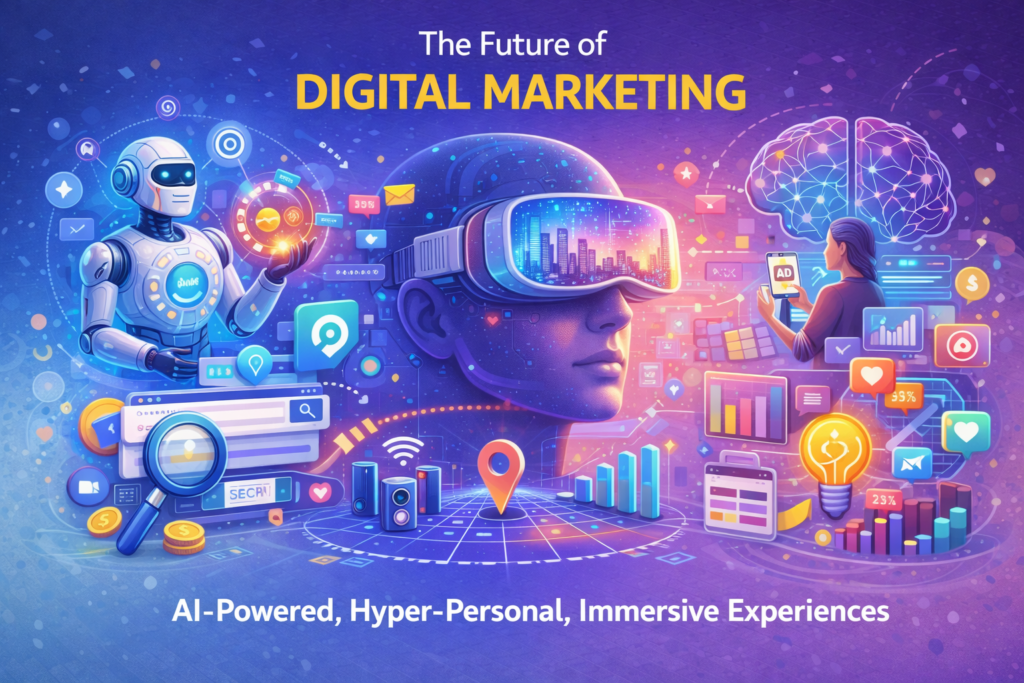
The future of digital marketing is a landscape shaped by immediacy, immersion, and insight.As consumers become savvier digital natives, brands must shift from broad‑stroke campaigns to hyper‑personal, instant experiences. AI‑driven automation will streamline touch points, while voice, visual, and spatial technologies will turn interactions into immersive dialogues. Data will no longer be a by‑product; it will be the compass guiding every creative decision. The result? A world where marketing feels less like selling and more like serving the moment, the place, and the person.
AI and Automation
AI is not a buzzword anymore, it is a vehicle of the future campaigns. Machine-learning algorithms have the ability to forecast customer life-cycle phases, scale personalized content, and real-time ad optimization. With automation tools, creative teams are able to work on strategy and the heavy lifting of audience segmentation, bid management, and the performance reporting is left to algorithms. This synergy is what will determine the future of marketing: human intuition and algorithmic accuracy.
Voice Search Optimization
As intelligent speakers, in-car assistants and voice-enabled appliances are on the rise, Individuals are speaking to the web in a natural language. The next generation of discovery will be dominated by brands that predict voice patterns, such as long tail questions, natural phrasing, local context. Voice SEO is not about stuffing keywords, but it has to be structured data, brief answers and fluent conversation user experience, making any voice query a conversion point.
Interactive Content
Still banners are being replaced by games, quizzes, polls, and AR overlays where the user can engage. The interactive media leads to increase in engagement, dwell time and data on user preference is richer. Interactive storytelling will be the new standard: a message of a brand will transform in real time to suit the preferences of the audience and make them feel the ownership and a stronger emotional appeal.
Augmentation and Virtual Reality (AR/VR)
AR and VR are changing the way we see the product prior to making a purchase. The virtual try-on to the fully-realized brand world are innovations that break down the digital and physical divide. With hardware getting cheap, and content creation tools reaching maturity, AR/VR will allow hyper-realistic demos, backstage tours, and completely interactive shopping experiences, and will usher in a new age of experiential marketing.
Data‑Driven Marketing
The real game-changer is that it is possible to transform large amounts of data into actionable insights. Predictive analytics, real-time dashboards and causal attribution models enable marketers to experiment, learn, and iterate faster than ever before. Strategies that are data-driven guarantee that all money is supported with evidence, all messages are highly-tuned and all campaign ads are made on the fly. In this data-centric ecosystem, relevance and impact are more important metrics of success than reach itself.
Common Challenges in Digital Marketing
Marketing today is a high‑stakes arena where brands must juggle shifting consumer habits, tightening regulations, and rapid platform evolution. Digital marketing is not a choice anymore it is a necessity to any business willing to prosper in the contemporary economy. Knowing its fundamental values, and remaining agile, you can use its power to attain impressive growth.Here are some common Challenges that are faced by Digital Marketing:
Ad Fatigue
Repetitive ads create a sense of boredom which leads to recurrent personalization and targeting delivers that diminishes the engagement and ultimately results in cost increase. We can overcome this problem by turning things creatively around, dynamic content, and segmentation to obtain fresh message. Introduce frequency limits and track performance indicators to initiate refresh before one gets tired.
Privacy Issues
Regulations such as GDPR, CCPA, and changing platform hampers the privacy controls and keep reducing the extent of data collection and decreases the accuracy of targeting.
By Introducing privacy-first principles (such as data minimization, transparency), switch to contextual and first party data, and invest in consent-management systems we can overcome such challenges.
Changes in Algorithms
Updating the algorithm of platforms (e.g., switching to relevance scoring in Facebook) may in a heartbeat cut organic reach and raise ad cost.
by diversifying the channels, continue testing and optimization of creative, and target high-quality content that is platform aware. Keep a fluid budget and be on par through industry notifications.
Intensifying Competition
Increasing number of brands compete on similar keywords, ad placements and audience attention, increasing CPCs and making differentiation more difficult resulting in one of the biggest hurdle.
Redefining the audience personas, micro-target, develop powerful brand stories. Use niche verticals, long-tail and alliances to be special can help to mitigate such challenges.
Demand to Learn Incessantly.
The emergence of new tools, formats (e.g., TikTok ads), and analytics techniques due to the rapid growth may scramble the staff.
Organize continuous learning- allocate time on training, subscribe to newsletters in industry, participate in webinars, and develop the culture of experimentation. Make evidence-based decisions on skills improvement and adoption of tools.
By pre-emptively handling all of these issues, marketers will be able to maintain campaigns in a robust, adhering, and competitive digital environment in the constantly evolving world.
Explore our recent blogs
Tags: