

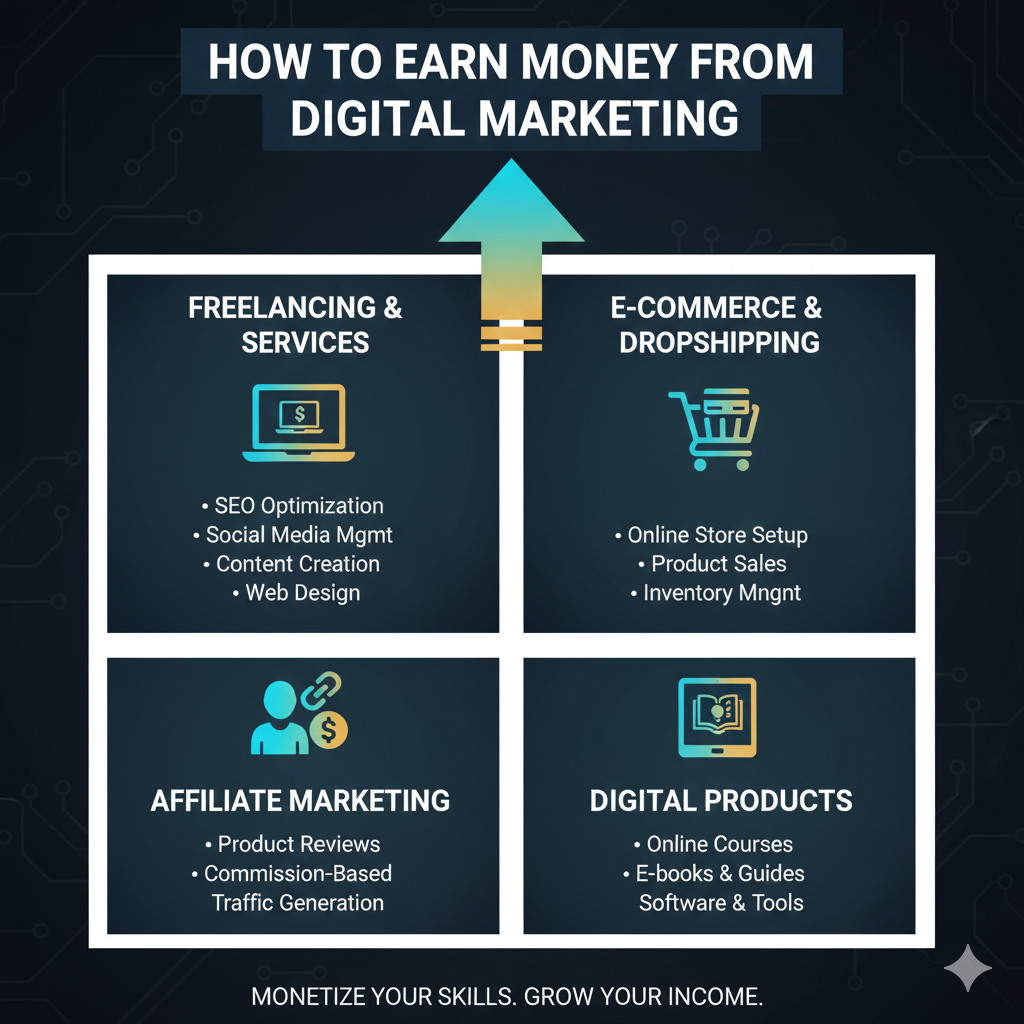
Digital Marketing has become one of our basic need in almost every field. Many are making six figures in one month through Digital Marketing. So, let’s see what are the ways we can Earn money from digital marketing.
Digital marketing is a flexible business that involves a combination of innovativeness, data-driven approach and incessant trial and error in making money. You create a niche, be it affiliate promotion, social media management, or e-commerce SEO, then turn around and create a solid online presence by having a high-traffic site or an active social media feed.
The second step is monetizing traffic through a combination of display advertising, sponsored content, and affiliate links, again, without violating platform rules. Move to paid advertising such as Google Ads or Facebook Campaigns, optimise ROI using A/B tests and conversion tracking. Alternate income: attempt consulting, create courses or create digital products including e-books and templates. Use analytics to track the key metrics such as CTR, CPC and CPA and optimize campaigns to be as profitable as possible.
It is possible to find a partnership deal and an increased commission through developing a solid personal brand, connected with influential influencers in the industry.
Lastly, remain agile, digital marketing is changing quickly and thus constant learning and change of algorithms keep your income climbing steadily.
How to Make Money with Digital Marketing?
It can be broken down into ten powerful, interlocking strategies that turn skills into cash,
- Affiliate marketing – promote products on blogs, social media, or email lists and earn commissions for each sale.
- Freelance services – offer SEO, PPC, or content creation on platforms like Upwork or Fiverr and charge per project or retainer.
- Digital agency – bundle services for small businesses, scale with a team, and command higher monthly fees.
- Product launch – create and sell digital courses, ebooks, or software, leveraging your audience for rapid revenue.
- Lead generation – build niche lead magnets, capture contact data, and sell qualified leads to B2B firms.
- Ad revenue – run high‑traffic blogs or YouTube channels and monetize through Google AdSense or native ads.
- Consulting – provide strategic marketing audits and paid workshops to companies seeking growth.
- Influencer marketing – partner with brands for sponsored posts, affiliate links, and product endorsements.
- Mail marketing – build a paid newsletter or loyalty list and charge for exclusive content or product deals.
- Data‑driven insights – analyze campaign metrics, offer predictive modelling services, and charge for actionable reports. B
By mastering a mix of these tactics and continuously optimizing based on analytics, you can build a diversified digital marketing income stream that grows with your expertise.
How to Get Clients for Digital Marketing?
Clients are essential for any product or service to demonstrate its potential within its respective field. So here are few steps which an online brand must follow to attract target audiences.
Analyze the market and find a niche that you can focus on and make a clear value proposition, that you will address certain pain points of that audience.
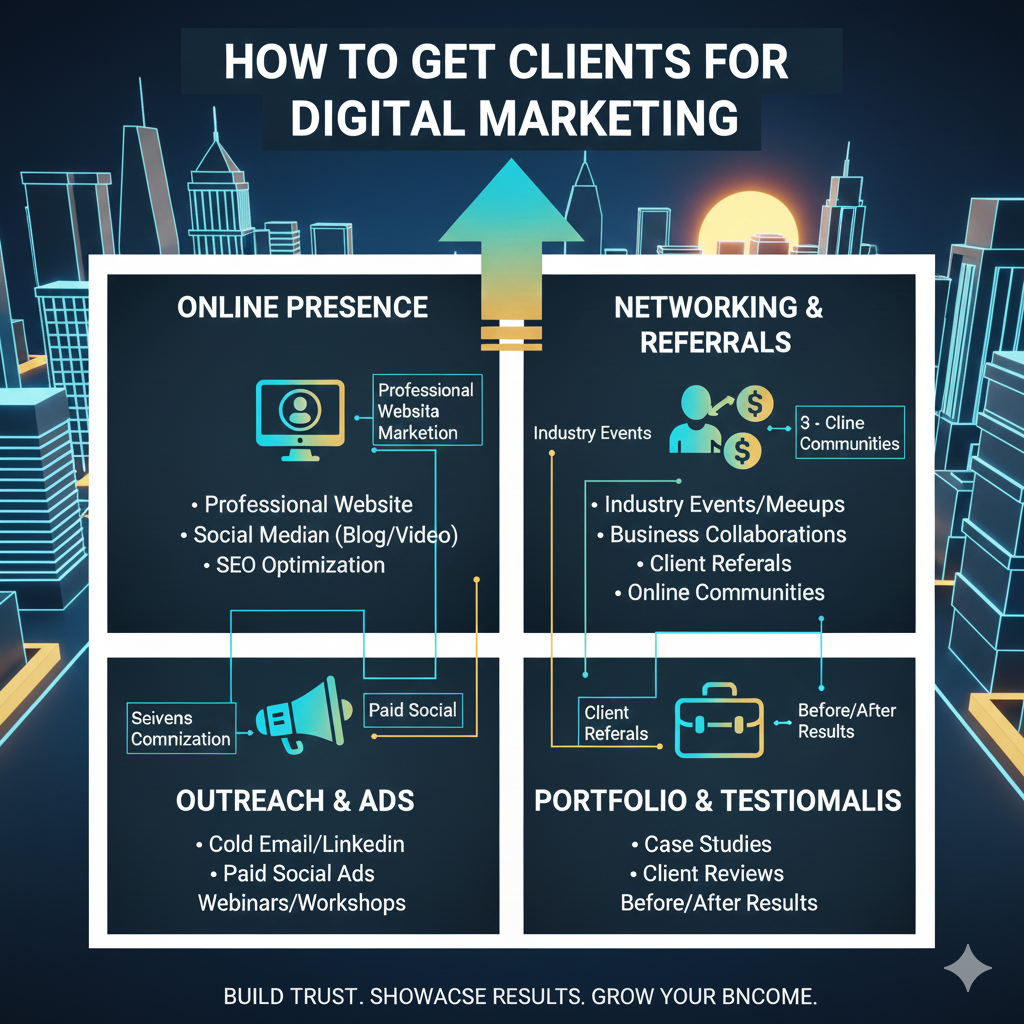
Create and present a strong portfolio and case studies that mirror concrete outcomes and present them on your webpages, LinkedIn, and forums within your industry in order to become credible. Use the inbound marketing approach to inbound marketing by producing high-quality content including blog posts, videos, and downloadable guides that will make you a thought leader and organic traffic.
Social media should be used strategically; here the postings need to be constant in the sites the prospects frequent and direct mailing should be done through responding to their posts and comments so as to create a rapport with them. Connect through a personalized cold email or LinkedIn message that includes information about one of the current problems of a customer and offers a super brief, fact-based audit or strategy call, where the pitch must remain to the point and benefit-oriented.
Visit industry events, webinars, and local meetups to meet people in person, never without trading business cards, and never without sending personalized email and mentioning in your reply that you were talking to them. Make happy customers advertise you with benefits and place their reviews in a visible place because the ability of word of mouth is the best tool in terms of gaining new customers. Run paid retargeting on social networks, keeping the eyes on the prize by having people who visited your site, but no action, become more engaged, optimising creative.
Measure and track all outreach: open rates, reply rates, conversion rates and repeat very fast, refining messages and targeting to become more efficient. Lastly, have a set of prospects by already putting up automated drip sequences in email that will cultivate leads into longer term clients of high value.
What is ORM in Digital Marketing?
Online Reputation Management, often abbreviated as ORM, is the science in the publicity of tracking, directing, and moulding the actualization of a brand, person, or company in the web. When using digital marketing it would be to keep searching in search engines, social media feeds, review sites, forums and news outlets to find references and feeling about a business and its current status.
After the insights have been collected, marketers create the responses and share the positive content and respond to the negative feedback in an active manner, and in many cases, resort to the practice of SEO to place positive stories on a higher position in the search results. Good ORM will cover both reducing the possible crisis, including a viral negative review or a defamatory blog, but will also enhance the genuine customer experience, creating trust and credibility.
Through the incorporation of ORM within a wider marketing strategy, organizations have the opportunity of safeguarding their brand equity, generating new field of customers and eventually converting online perceptions into a reality of a business venture.
Is Digital Marketing a Good Career in India ?
Well, answer to this question is YES. Digital marketing is a highly promising career in India due to the country’s rapid digital transformation and growing reliance on online platforms. Businesses of all sizes like start-ups, local brands, and large enterprises are shifting their marketing budgets from traditional advertising to digital channels.
This shift has created a massive demand for skilled digital marketers who can manage social media, SEO, paid ads, content strategy, and analytics. India’s booming e-commerce market and increasing smartphone usage further fuel this demand. The industry also offers flexibility, remote work opportunities, and high earning potential. With the rise of AI tools, companies need professionals who can combine creativity with technology.
Moreover, digital marketing roles are diverse, allowing specialization in areas like content writing, SEO, social media, and performance marketing. Anyone with strong communication skills and a willingness to learn can grow quickly. Overall, digital marketing provides long-term stability, growth, and endless opportunities in India.
How Many Main Pillars Does Digital Marketing Have?
Digital marketing is based on the five pillars which build a complex strategy:
- Search Engine Optimization (SEO)- page optimization, technical infrastructure and writing to be high on organic search engines, and get authority traffic.
- Content Marketing– production of valuable, evergreen content may be in the form of blog posts, e-books, videos, and others that educate their prospects and build trust and brand authority.
- The campaign will be conducted according to the principles of Social Media Marketing, where the Web will be used to promote the content, community, and brand voice due to paid and unpaid strategies in Facebook, Instagram, LinkedIn, and Tik Tok.
- Email Marketing -nurturing triggers personalized and targeted campaigns and drip series that guide subscribers through the buyer process to completion.
- Paid Advertising (PPC & Display)– search ads, social ads and retarget advertising deployed to boost visibility, lead intent and reach size in a short period.
These pillars are mutually dependent since each depends on the others to achieve their objectives: SEO drives content awareness, social expands content coverage, email cultivates leads that arise as a result of paid efforts and analytics ties the two, by assessing performance and adjusting strategies. Together they create a strong, data-driven platform which achieves an ROI that is measurable throughout the customer lifecycle.
Recent Blogs
Tags:
Comments (3)
AR and VR in Marketing: Immersive Strategies to Boost Engagement
says December 18, 2025 at 4:04 am[…] At the same time, AR and VR significantly lower product returns. Most returns happen due to mismatched expectations like size, color, fit, or the product not looking like the images. But when you preview products in your own environment or on yourself, they know exactly what they’re getting. This accuracy reduces disappointment and cuts down on unnecessary returns, making AR and VR a smart strategy for brands looking to Earn From Digital Marketing. […]
Top AI Ranking Factors for SEO | Best AI-Driven Search Signals
says December 22, 2025 at 11:41 am[…] How to Earn Money from Digital Marketing? […]
How to Choose a Digital Marketing Agency in Gurgaon?
says January 07, 2026 at 10:25 am[…] digital marketing agency helps Gurgaon businesses by improving their online presence, generating qualified leads, and […]