


Search Engine Optimization is the art and science of intensifying the visibility of a given site on the search engines such as Google, Bing and Yahoo. When users key in questions in a search engine, the search engines give them information on the most pertinent billions of pages. SEO can be defined as the manoeuvres which make a site seem to be at the top of such search results; preferably on the first page.
Full Form of SEO
There is such term as search engine optimization that can be defined as the act of optimizing a website to be ranked on the search engine result pages (SERPs).
Definition of SEO
Essentially, SEO is a mixture of technical optimization, content strategy, and link-building in a manner that informs search engines that your site is authoritative, relevant, and helpful in particular keyword or phrase.
How SEO Works?
- Crawling & Indexing
Bots (crawlers) are engines used by the search engine when scanning the internet. You see them reading your pages, clicking, creating an Index, a mammoth database of everything that they have ever read. SEO makes sure that your sites get crawled and indexed.
- Relevance & Ranking Signals
When signing out a query, search engines compare your page to millions of factors:
- Keywords– You employ the query in titles, headings and in body?
- On-page cues– meta tags, URL design, alt text of images and internal linking.
- Quality of content– depth, freshness and uniqueness.
- User experience – Fast speed of page load, mobile-friendly interface and low bounces.
- Power of position/authority: the backlinks of trusted websites which are considered as a vote of confidence.
3. Ranking
All these individual factors lead to a total score. The score, the larger the ranking of the page on that query. SEO is not a permanent solution, but a continuous process of improvement and change.
How to Start SEO with Quick Tips?
- SEO is literally that occupancy between your site and the millions of individuals searching information, goods, or services you sell or provide. With the help of knowing what SEO is, what it is and how it functions, the process of creating a plan that draws more organic traffic and turns random shoppers into regulars, will be achievable.
- Keyword research – Find out what your readers say.
- Maximize on-page components– Title tags, header and meta description need to contain your target keyword.
- Produce quality content– Address the questions that are being posed, multimedia, and keep it current.
- Establish Quality Backlinks in the industry blogs, guesting, and become resourceful.
- Check performance – Monitor performance by using such tools as Google Search Console, Analytics, and rank-tracking software.
The Importance of SEO
In the digital world, just having a website is not sufficient anymore. One has to be discovered by the audience. SEO is the mechanism that drives your website Into the limelight. Combining your content, structure and technical configuration with the algorithms that drive Google, Bing, and other search engines will make you provide a smooth transition between what the users are searching and what you are providing.
This is the key to the online development and without it even the most sophisticated site will be left to rot in anonymity. SEO in a nutshell is the hidden engine that guides traffic to your online door step and makes them your customers.
Keyword Optimization can Improve Traffic
Any online venture is the blood of traffic. SEO changes how the search engines understand and rank web pages and make sure that the appropriate key terms direct the appropriate traffic to your site. Through extensive keyword study and placing the keywords across the constructive titles, meta description and the content, you are not only addressing people in the language they comprehend, but you are also satisfying the algorithms. Such a twofold orientation causes increased rates of click-through and a more healthy profile of the visitors.
Besides, SEO promotes content that provides real answers, which not only satisfies search engine users but also provides more dwell time, also one of the critical measurements of relevance used by search engines. The result? A steady stream of organic traffic that does not cost a single cent per clicking but, instead, provides a long-term value.
Using SEO to Take Your Business Global
Being found is not visibility but rather being found in the right context. SEO can put you in the right place in the 3-pack of a local bakery or the number 1 organic search results of a global SaaS software. Optimization of the visit type to local search and schema mark-up, and mobile responsiveness will make you visible in the search field on desktop and mobile platforms.
Moreover, an effective backlink and a reputation of being authoritative will initiate search engines that you are a credible source, which will increase your rankings in various locations. High visibility will draw in even more clicks but create some brand credibility since visitors tend to have better brand association with higher ranking in the search results.
Cost Effectiveness and Sustainable Growth
Contrary to paid advertising, which ceases to proceed sending traffic once the fund is depleted, SEO provides a long-term engine to growth. The initial cost (time, research and, perhaps, professional assistance) will be paid back through the continued returns on your pages as they gain authority, and relevancy. A high ranking page will still attract traffic in years with little maintenance hence it gives you a competitive edge over your competitors who will only have to use paid media. SEO is, too, complementary to other digital marketing activities: social media, email campaigns and content marketing all experience quantifiable boost when combined with strong SEO foundations. It increases reach, lowers the costs of customer acquisition, and brings a virtuous cycle of engagement and conversion.
Strategic Advantage of SEO
Overall, SEO is not just a technique of gaining top positions, it is a skillful field of study that increases growth, drives traffic and visibility. Thoughtful keyword research, technical excellence and authoritative content help you gain access to all the potential of your online presence.
The reason why SEO is so relevant is fairly obvious: it transforms the previously unseen performance into the actual performance, making browsers customers, and clicks into long-lasting relationships. The fruit of SEO cannot be measured by the numbers only; the fruit of every good work can be expressed in continuous, progressive motion to keep your brand in the lead.
What are the Types of SEO
Search Engine Optimization can be divided into the four complementary areas that individually assist a site in its ascending the rankings and in getting the appropriate visitors. On-page SEO is concerned with the text and the build of the HTML of every individual page. Off-page SEO will create authority in a site by issuing backlinks, digestive signals, and brand mentions that communicate a sense of trust to a search engine. Technical SEO is concerned with the back-end infrastructure as a system of site speed, mobile-friendliness, crawl-ability, and structured data to provide search engines with an easy map to your content.
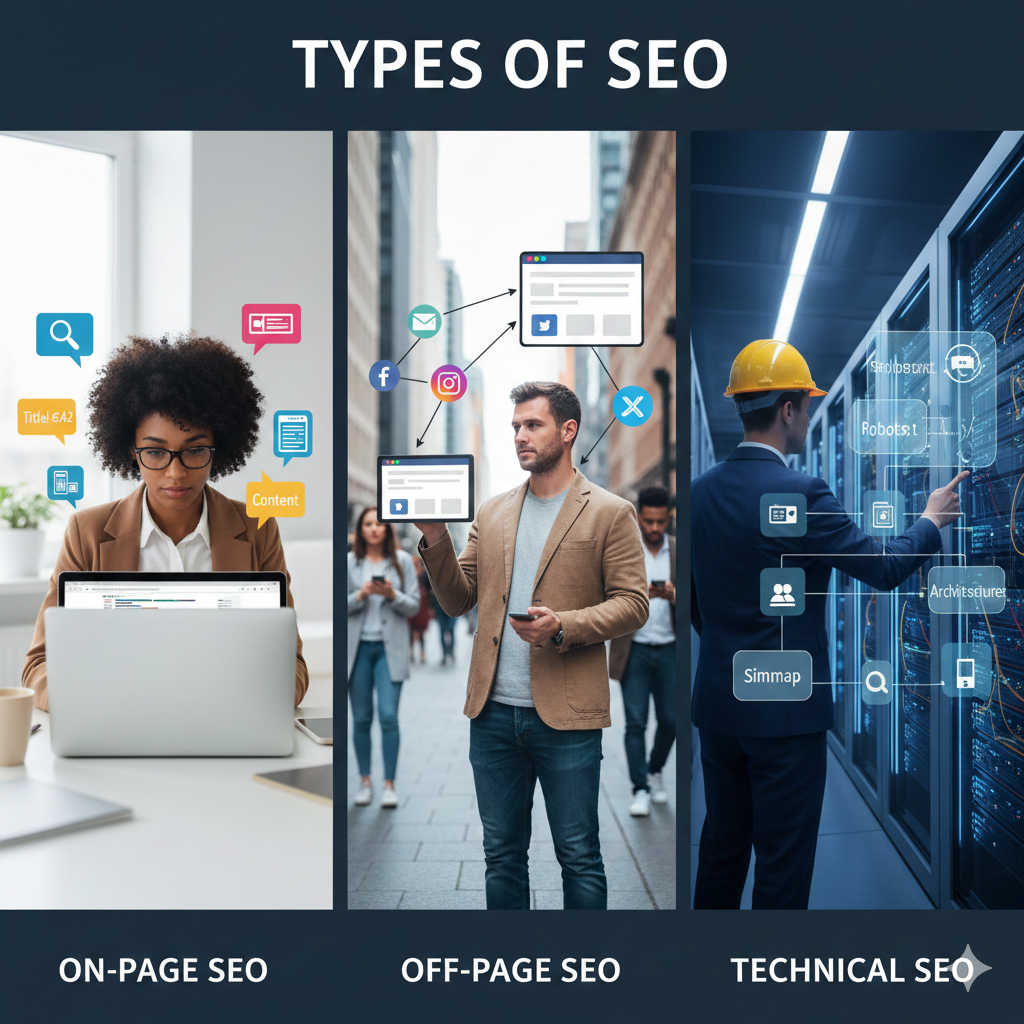
Lastly, the Local SEO will focus on those who search the services or the product within their vicinity, the business is optimized, gets reviewed, and geo-specific content. All of these types create a comprehensive approach that leads to visibility, relevancy, and conversion.
On‑Page SEO
On-page SEO is what it is all about, optimizing each page in order to be ranked higher in the search results and be useful to the user. It firstly involves the use of keyword research, which involves which words Google users actually enter into the search engine, and then makes those keywords occur naturally within titles, metadata descriptions, headings, and the rest of the text.
The quality of the content is most important: search engines prefer detailed and properly organized and updated pages. HTML tags, e.g. title tags, alt attributes and schema mark-up, provide machines with additional information regarding the purpose of your page. Internal linking assists to spread the equity of the links and retains the visitor on your site whereas image optimization (compressed files, descriptive names) increases load profiles and accessibility.
Lastly, making the page friendly to a mobile device, and loading it within a relatively short time is an indication to customers and search engines that the page is worthy of ranking.
Off‑Page SEO
Off-page SEO is based on outward factors which display the authority and the reliability of a page. The most important one can be considered to be back links: good links of recognized sites serve as references, informing the search engines, that your content is valuable. The signal is reinforced by the anchor text, and a variety of linking domains.
Social signals posts, likes, and comments, which are not considered direct ranking factors, enhance visibility and might result in more organic backlinks. The mere mention of the brand (without a linkage) also transfers towards perceived authority.
Another activity that will produce and create organic backlinks and build brand awareness, which feeds back into higher rankings, is taking part in guest posting, partnerships, and involvement in online communities.
Technical SEO
Technical SEO is what forms a base that enables the search engines to read, index and rank your site effectively. There should be a clear and logical hierarchy structure with clean URLs, so that crawlers may retrieve new pages. Search engines are directed on what pages to crawl and when by use of robots.txt and XML sitemaps.
Speed Matters: diagnostic tools such as Google Page Speed Insights diagnose bottlenecks, and so can Accelerated Mobile Pages (AMP). Encryption must be done using HTTPS because of its security and ranking. Adoption of schema.org is useful in enabling search engines to use rich snippets, which increases the rates of clicking. The last is periodic checking of crawl errors, and regular repairing of broken links keep the site health score a low score.
Local SEO
Local SEO is a target that the users are products, services or information that are found within a given geographical location. The most apparent of it is the so-called Google My Business (GMB) listing that is fully furnished with a correct NAP (Name, Address, Phone), business hours, quality photos, and uniform hours match across platforms.
Local citations Local citations such as on directories (Yelp, Bing Places, industry-specific directories) assist in strengthening the NAP consistency. The fact that we have reviews is a strong exercise of credibility; replying to those reviews will demonstrate interest and potentially influence the behaviour of prospective clients. Relevancy is enhanced by optimizing local keywords (e.g., coffee shop in Brooklyn) and developing location-specific landing pages. Lastly, mobile-optimization and local schema micro data make sure that your business is in prominent appearances at the near me searches and local packs.
How Search Engines Work?
Search engines are advanced systems which search all over the web, organize the information they encounter and provide the most applicable to the user in milliseconds. They start by dispatching automated systems known as the crawlers (or spiders) to find web pages.
After a crawler discovered a page, it sends the content to a huge database in which the search engine indexes the content – extracting text, links, images and other metadata. Search engines have web crawling features that find and catalogue the content and page ranking which are complex web engine algorithms.
Crawling
The initial step in the working of a search engine is crawling. Spiders are also called automated bots, as they will explore the web, as any web-seeing robot does, using the same hyperlinks. They put more emphasis on ranking sites according to the probability of new or new material using hints through the sitemaps and robots.txt file as a consideration of preferences of the site owners.
Upon crawling a page, a crawler downloads the HTML, downloads other resources used with it (images, CSS, JavaScript), and processes the page to find out other links. Imperative information recorded by the crawler includes the URL of the page, last-modified date and the data of the HTTP header. It then drains the raw material and metadata to the indexer where it is further processed. The constant crawling will keep the database of the search engine up to date and in line with the dynamism of the web.
Indexing
Indexing converts unprocessed crawled data to a searchable format. The text is tokenized first in the engine (it is divided into words and phrases, and the stop words are eliminated). It then creates an Inverted index (a list of terms to the documents containing them) enabling the engine to find pages matching a query swiftly.
The index contains a link information (who links to whom), page metadata (title tags, meta description), and content type information (text, video, images) besides text. Other page attributes that are determined by the indexer include frequency of words, anchor text and position of words in the page (title, header, body). After storing the data, the search engine maintains the index with new pages when they are altered and re-crawled and re-indexed again thus providing the users with the most up to date information.
Ranking
It is also referred to as ranking as the search engine algorithm converts a list of candidate page into a series of results listed in a sequence. Signals that are thought to be important are on page factors (keywords relevance, title tags, schema mark-up), off page factors (back links, domain authority, trust indicators) and user experience indicators (Page speed, mobile friendliness, click through rate).
In Modern Ranking models, machine learning is used to rank them, constantly learning through user engagement and feedback. The ranking mechanism used by Google, say, involves freshness, current relevance and even locality in order to come up with the most ideal answer to a query. Finally, the engine will apply a score to every page and rank them in descending order with the most relevant and credible information coming out first.
What are the top SEO Tools ?
The optimal SEO tools are a need to increase traffic and visibility, as well as to detect site problems and monitor performance. The most popular among them include Google Search console, which is free and offers data-driven insights, as well as SEMrush and Ahrefs that let you conduct a thorough research on the keywords, backlinks, and competitors and Moz, which has a user-friendly interface and community-related resources available to them. Collectively these applications constitute a powerful package to any web site owner who wants to rank high in search.
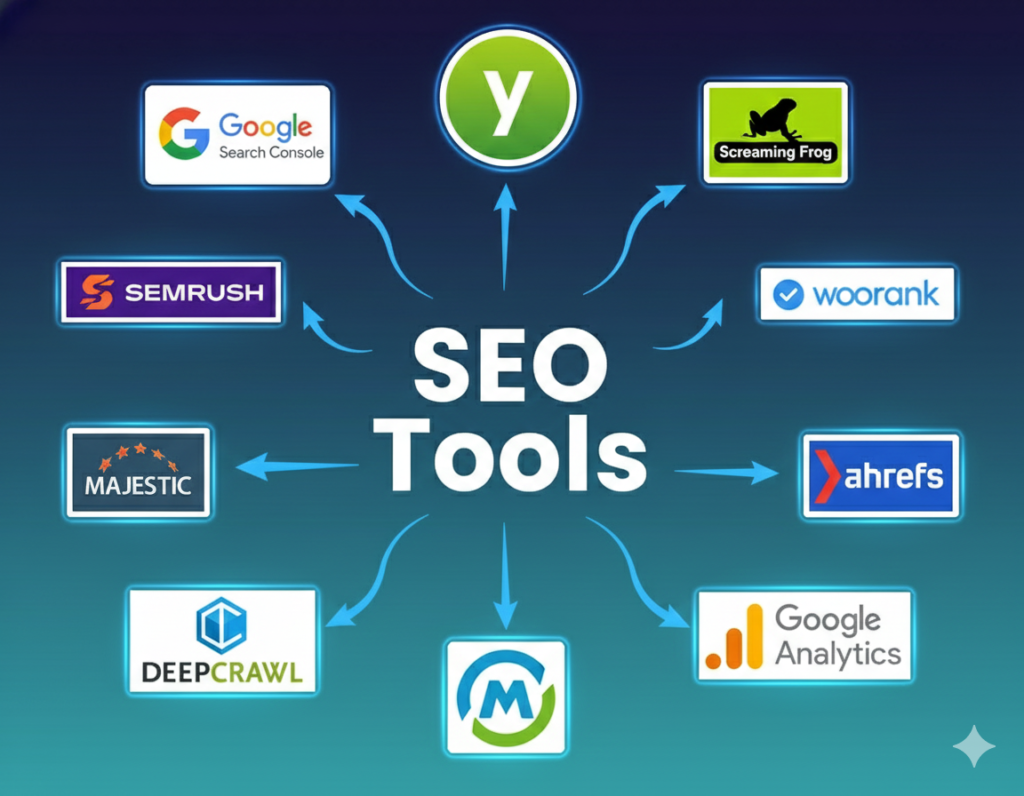
Google Search Console
Google Search Console (GSC) is a free yet inseparable tool of every webmaster. It offers real time information on Google crawling and indexing of a site with impressions, clicks and click through rates. Other critical issues monitored by GSC are crawl errors, mobile usability problems and security breach. Using search query and position reports, it is possible to identify underperforming pages and ensure their content is optimised. Additionally, GSC allows to submit sitemaps and robots.txt, and take direct control over the indexing process by Google.
SEMrush
SEMrush is a unified paid tool that is very successful in terms of determining the keywords, site audits and competitive analysis. The magic tool of its keyword optimizes millions of keyword variations and search intent data and allows you to find the right phrases. The site audit option scans the site in search of technical search optimization problems such as broken links, duplicate content and page speed bottlenecks and provides actionable remedies. The backlink tracker provided by SEMrush monitors the quality of the links and determines the possibility of toxic links which would disadvantage the ranking. Lastly, its position tracking feature allows keeping track of the SERP classification over the course of time, which gives a clear picture of the efficacy of your SEO strategy.
Ahrefs
Ahrefs boasts of a vast backlink index and powerful key word explorer. Site Explorer tool helps to understand who provides links to your pages, quality of such links, and distribution of anchor text to incorporate link-building techniques. The Keywords Explorer of Ahrefs offers information on their search volume, difficulty, and click-through-rate on Google, YouTube, and Amazon, which can be useful when launching a campaign on many platforms. Site Audit functionalities identify technical problems like slowness in loading of pages, page duplication and crawling errors and provide priority based recommendations. Furthermore, Content Explorer of Ahrefs presents the ideas of high-performing content according to backlinks and social shares to enable the creation of the content based on the information.
Moz
Moz is a company that provides an equal combination of free and paid tools that are helpful to both beginners and professionals in SEO. Its Link Explorer provides the overview of domain authority, page authority, and link metrics that are crucial in completion of the evaluation of the quality of links. The Keyword Explorer brings together search volume, keyword difficulty with a special Opportunity metric, which assists in priority search of keywords that are both satisfy-able and desirable. Site Crawl in Moz identifies crawl problems, duplicate content, missed links within the site and also displays the visual architecture of the site. The MozBar delete-all-you-need extensions can provide immediate SEO data in your browser in the form of Page Authority, Domain Authority, and link data, which can be analyzed in seconds and on-the-fly.
Google Algorithm Updates
The search engine at Google is a breathing, living machine that is a continuous development in order to provide the most appropriate and the best to the searcher. All the modifications, be it a small detail or a radical overload, are supposed to beat the spam, reward the worthy content and ensure that the search results stay fresh and reliable.
Panda
Panda began in 2011 in an effort to stem out sub-standard, low-demising or replica content that filled out search results. The algorithm searches the parameters of keyword stuffing, shallow depth, and lack of originality and punishes sites that do not have much value to their readers.
The most effective area where Panda makes its influence is the quality dimension: pages with numerous, properly organized and informative content are improved, whilst the ones powered by content farms tend to fall significantly down the ranks. Panda is now a pillar of Google quality first philosophy which is encouraging people to take time and consider their audience, and invest in quality, rich material.
Penguin
Launched in 2012, Penguin is aimed at link-building manipulation techniques that change ranking in search. It checks on the quality and relevance of incoming links seeking trends of spam, link schemes or paid links that are undisclosed. The main objective of penguin is to restore the visibility of those websites which gain links naturally due to perceived authority and relevance and to demote those websites which use black-hat link farm or links reciprocation strategies.
Due to the continued relevance of link quality as a ranking factor, Penguin has necessitated SEOs to pursue clear, value-based link-building tactics, and has even resulted in a more healthy and trustworthy web environment.
Core updates
Core updates are high-level modifications that are regularly implemented (usually once a month) which resets the entire ranking engine of Google. In contrast to targeted updates, such as Panda and Penguin, core updates are not aimed at a particular factor, but rather, they tune the balance of hundreds of signals- relevance, freshness, user experience, and quality of the content- in one way.
Websites can either go through small period changes or fly in and out of the rankings of how close they are to the new algorithm priorities. In the face of these sweeping algorithm changes, the emphasis placed on core updates is to achieve intent, usability, and technical health instead of pursuing one tactic alone is resilient to such changes.
What are the Ranking Factors in SEO?
Google uses thousands of signals in evaluation of the algorithm though there are a few important aspects that contribute to higher ranking all the time. Domain authority, back links and content quality are the most influential. The three of them create a solid base: authority defines trust, backlink proves relevancy, and new and useful content will keep the users interested. With the mastery of these three pillars, improved visibility during search results is received.
Domain authority
Domain authority (DA) is an indicator that is a composite measure providing an estimate of the likelihood of a site to rank well on search engines. It is computed based on various indicators, such as the age of the domain, number of external domains connecting to the domain as well as site credibility. Having a high DA will tell Google that your site is a search engine that can be trusted, and thus it is more probable to be ranked at the top of the search results. DA is, however, not a ranking factor in itself, rather, it is an indication of the factors which Google does take into consideration.
Backlinks
The digital generalization of the recommendations is the backlink: each link on another website tells Google that your content is worthy. Quality is more than just quantity; the connections to the trusted and topical sites are much more important. The search engines use the anchor text as well as the position of the link and context that the link is placed in to determine the level of relevance. With a healthy backlink profile, it would show that there is a sense of trust and that your site would rise on the ranking with time.
Content quality
The main factor of SEO is content quality, or E-A-T (expertise, authority, trustworthiness). Well researched material that provides answers to queries by the people is a rich material that indicates relevancy to Google. Organized information, entertaining multimedia and purposeful formatting enhance readable and interactive information. By continually updating content, one makes it fresh, which strengthens its authority as well as inviting repeat visitors, both of which can boost your placement in the rankings.
Common SEO Mistakes
There are some pitfalls that many web publishers use, which destroy their bondage position on search engines. The most harmful ones are key word stuffing, copied content, and slowness of the page. These are mistakes that damage visibility and in the process madden users a negative signal to search engines. They are necessary to avoid, otherwise, you will not create a high-ranking and sustainable site.
Keyword Stuffing
The key word stuffing is where you overload the content that you are filling with the same word or phrase in your content, meta tags or alt text. This is seen by the search engines as trying to play with the rankings and they tend to penalize the page. The slightest excess use can lower the readability, which makes the visitors question the credibility of your material. Rather, make the point to use natural and user-friendly language that includes keywords at near-average density. Use the variations and other related terms to show that it is topical but not over- optimistic. It is worth bearing in mind that when it comes to quality, relevance is much better than the quantity.
Duplicate Content
Duplicate content can be defined as the text on the two or more pages, either in the same site or the web. The search engines have difficulty over determining which of the two versions to index resulting in loss of ranking or indexation. Frequent sources are the copying product descriptions of the suppliers and syndicated articles or bad settings of URLs. In the process of eliminating duplication ensure that you come up with unique interesting pages, in case of the need to do so use the canonical tags. Test your site on a regular basis using applications such as the Copy-scape or Screaming Frog to identify hidden duplicates in their infancy. You can achieve this by making every page as much as possible valuable to visitors, and this sends a message to search engines that this is an authoritative site.
Slow Speed
The ranking factor of speed on pages is very critical and plays a significant role in determining the user experience. Facebook pages that load slowly cause bounce rates to increase, solve time reduces and even search engine penalties. Suggestions to increase the speed are to limit the size of image files, render-blocking JavaScript, and unresponsive server response times. Images can be optimized, CSS/JS can be minified and browser caching will reduce load times significantly. Measure the progress and bottlenecks to track using tools like Google page speed Insights or GTmetrix. Not only does a fast and responsive site rank higher it keeps the visitors hooked and makes them respond.
SEO for Beginners
Search Engine Optimization (SEO) is an art and science of exposing your site to more people searching online. To this end, to the novice, the first stage is mastering how search engines crawl, index and rank information, and the final stage is mastering on page optimization and linking as well as analytics. You can learn step by step and develop a strong foundation which makes those casual visitors loyal customers.
Step‑by‑Step Learning Path
Start with SEO Basics
Get deeper into the fundamentals- keywords, SERPs, meta tags and Major difference between on page and off page search. This background knowledge enables you to observe how search engines rank the relevance and authority.
Keyword Research & Intent
Master the techniques of finding high-value terms in Google Keyword Planner or Ahrefs and align the terms with user intent: informational, navigational, or transactional. This act is to guarantee that your content is to the point of what people literally are searching.
On‑Page Optimization
Learn how to create title tags, meta descriptions, headings and URLs that are pleasing to the user and tricky enough to appeal to the search engines. The presence of an on-page set up with clear and keyword-rich optimizes both the ranking and the click-through rate.
Technical SEO
Learn by doing site speed, mobile friendliness, schema mark-up, and XML sitemaps. Crawl-ability and indexability rely on technical health, not resulting in expensive penalties or ranking drops.
To do this, link building and content promotion can be used.
Develop trustworthiness by getting high-quality backlinks via outreach, guest postings and shareable content. In combination with social promotion, this action increases power and triggers organic traffic.
This step-by-step guide will make you a SEO master in no time; start with the fundamentals of SEO, graduate to keyword research, on-page, technical and link optimization.
Advanced SEO Techniques
In the ever-changing and dynamic digital arena, it is necessary to master improved SEO to be ahead of competition. Combining innovative strategies (organized information, content hubs, and artificial intelligence-driven tools) will enable the marketer to increase visibility, as well as relevance drastically. Such strategies can ensure better positions in searches, better user experience and conversion.
Schema Mark-up
Schema mark-up, also known as structured data in your HTML, assists search engines in understanding the meaning of your content and results in more rich search results and increased click-through. Adding the products, reviews and events in JSON-LD can give the product a context that otherwise would be missed by the example crawler and make a boring listings into a very vibrant snippet. In the case of schema, you hint Google the importance of your content, and this may have a positive outcome in rankings and can lead to targeted traffic. You ensure that you stay current with the search engine guidelines and give your SERP a fresh look by auditing and updating the specks on a regular basis.
Topic Clusters
In topic clusters, your content of the site is arranged in the form of at least one main pillar page, and cluster pages that support it, forming a definitive topical authority map. This hierarchy allows search engines to know how in-depth your knowledge about a topic is, increasing topical relevance and crawl-ability. This interlinking of cluster pages back to the pillar is distribution of link equity and internal linking signals, as well as a boost to site authority. The addition of new cluster content regularly will make the hub dynamic and it will give signals to the search engine that your site is modern and in authority.
AI in SEO
Artificial intelligence is transforming the field of SEO by automating search, on-scale optimization and content generation. Artificial intelligence is able to process large amounts of keywords in seconds, link searching gaps, and propose high-impact areas quicker than any human investigator. They are also known to create meta tags, optimize pictures, and dynamically rewrite headlines according to dynamic changes in search intent which keep your pages positioned on the front line.
Also, AI-based audit solutions identify technical difficulties such as crawl errors and broken links to utilize them in the near future and improve the performance at any given time. With AI in your workflow, you open up to automation and release the resources to creativity without losing its accuracy and relevance.
White Hat SEO vs Black Hat SEO vs Grey-hat SEO
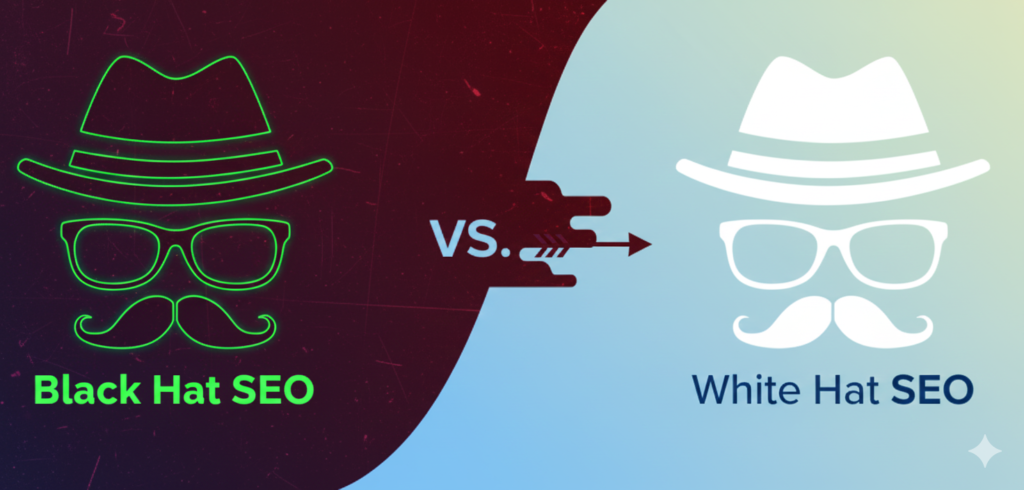
White-Hat SEO is the ethical practice of optimizing a website to improve its search engine rankings by focusing on human audiences. It strictly adheres to search engine guidelines and prioritizes quality content that is valuable, informative, and relevant to users. Techniques include thorough keyword research, creating an excellent user experience, and earning legitimate backlinks through outreach. The goal is to build a sustainable, authoritative online presence that stands the test of time. This approach may take longer to show results but ensures long-term stability and avoids penalties.
Black-Hat SEO refers to aggressive tactics that manipulate search engine algorithms to gain rankings, often violating official guidelines. These practices prioritize tricking bots over serving human users and include techniques like keyword stuffing, cloaking, and using private link networks. The primary goal is to achieve rapid results without regard for the user’s experience or the website’s long-term health. While sometimes effective short-term, these methods carry a high risk of severe penalties, including being completely de-indexed from search results, which can be catastrophic for a site’s visibility.
Grey-hat SEO approaches fall between those that apply practices that borderline but are not malicious. Whereas white-hat SEO establishes the traffic that is sustainable, black-hat methods may provide temporary spikes that tend to plummet when the algorithms usually recognize them. An astute marketer is neither reckless nor careless but he chooses to be a white-hat marketer in order to gain long-lasting power. In the end, the long-term result of white-hat and black-hat is favourable versus the short-term decision of white-hat application that will certainly neither change time nor is future proofed.
Ethical practices are actions that are morally right, fair, and consider the well-being of others. Embracing ethical practices in a web site makes it gain credibility, minimizes chances of getting a fine and brings about returning traffic. Ethics guide us to choose conscience over convenience and integrity over short-term gains. They serve as a moral compass for both personal character and professional conduct.
Unethical practices are morally wrong, deceptive, and cause harm for personal or organizational gain. Does not respect these principles, and instead, cheats its ways into search engines by creating deceptive content and link farms, which may cause harm to the competition and ultimately annoy readers. Unethical practices may improve the rankings in the short run, yet they may be met with fines, bad reputation, and reputational losses. Transparency and user-centricity triumph in the long-run as compared to intelligent but risky shortcuts.
Future of SEO
Artificial intelligence and voice search and the growth of the zero-click result are altering the future of SEO, pushing optimization more towards being conversational and contextual. The search engines now consider the intent of the user and the natural language and so they compel marketers to develop questions and answer content directly. Voice assistants are eager to receive short, question Ltd. whereas 0-click SERP proposes on-site visibility and direct responses. To remain at the top level, it is important to have the new updates of the SEO, be dynamic to keep up with these trends.
Google and other search engines feature artificial intelligence at their heart, with advanced ranking models such as Google it has BERT and MUM. These systems process semantics and context enabling algorithms to interpret nuanced queries as opposed to simple. In the case of SEO practitioners, this implies the concentration on high quality intentionally oriented content that caters to user intent in its entirety. Predictive personalization, generated by AI and serving specific behaviour and location to individuals, drives the need to move towards more granular audience segmentation by a brand. With AI in the future, it will be necessary to constantly update on the most recent SEO changes to remain relevant and visible.
Voice Search: The emergence of Conversational Queries.
Smart speakers and mobile assistants are changing web interaction trends where users can talk to their gadgets instead of typing their queries. The search queries are longer, connotative and mostly in the form of a question and thus the content has to be organized in the form of a FAQ or a question and answer. The voice content should also be fast loaded because users tend to use quick answers; local optimization and featured snippets are given importance. Moreover, voice search is more focused on mobile performance and voice-friendly schema mark-up, and thus, the technical change in SEO should be prioritized. The voice device proliferation is a good indication that search engine optimization will further become focused on conversational and more rich-context methods.
Zero-Click Searches: Asking to Receive the SERP Space.
Zero-Click searches are where the search engines present the answer on the search results page, according to which no user has to go through. The trend compels the SEO specialists to emphasize on featured snippets, knowledge panels, and structured data in order to achieve such an excellent real-time exposure. The brands should streamline the content to fit the specific wording of frequent questions of the user, usually using short, bullet-point or numbered lists. Even zero-click search results drive the significance of on-page optimization: quick loading, mobile-friendliness, and easy-to-use call-to-action buttons become essential to convert visitors that do not navigate off the search engine ranking. Keeping up with this change would require changing the content strategy in accordance with the recent changes in SEO that prefer one-point answers to be rather brief and thorough, as opposed to the old-fashioned page views.
SEO Myths & Misconceptions
The digital marketing sphere is full of the so-called SEO myths, and most of the businesses end up becoming victims to the outlived beliefs. The most widespread myth is that * keyword stuffing will continue to improve the ranking, and in fact, search engines attack over-used phrases. The next misconception is that the process of building quality links is one-time operation- good links should be built and nurtured.
There is a belief that mobile optimization is not a ranking factor and it is more of a nice to have feature; nowadays, mobile-first indexing is a requirement. Another misconception is that, many people imagine that, SEO is a short-time solution, however it takes long term planning and time. Last, the assumption of a combination of content length and increased rank is illusory; quality and relevance prevail over content.
Clarifying False Assumptions
Concepts of SEO are more likely to be wrongly conceived because of lack of understanding of how search engines access content. The idea that the ranking is mainly determined by the use of the so-called meta titles is a myth they also affect the quantity of clicks, but the algorithms emphasize the relevance and the purpose of the user.
Every link is not equal the phenomenon that the backlink is all the same categories as the links on reputable sites has more weight than the numerous low-quality links. There is a popular opinion that the social signals influence the rankings directly, and the reality is that social interactions increase the visibility but does not have a direct implication on search ranks.
Also, the fact that the assumption that the framework of the field of SEO consists only of technological issues disregards the significance of user experience and content strategy. The distinction between actual facts and myths of SEO allows the marketers to concentrate on actual strategies such as quality content, ethics in link building, mobile utilization, and optimization driven by data to attain long-term rankings.
Tags: