


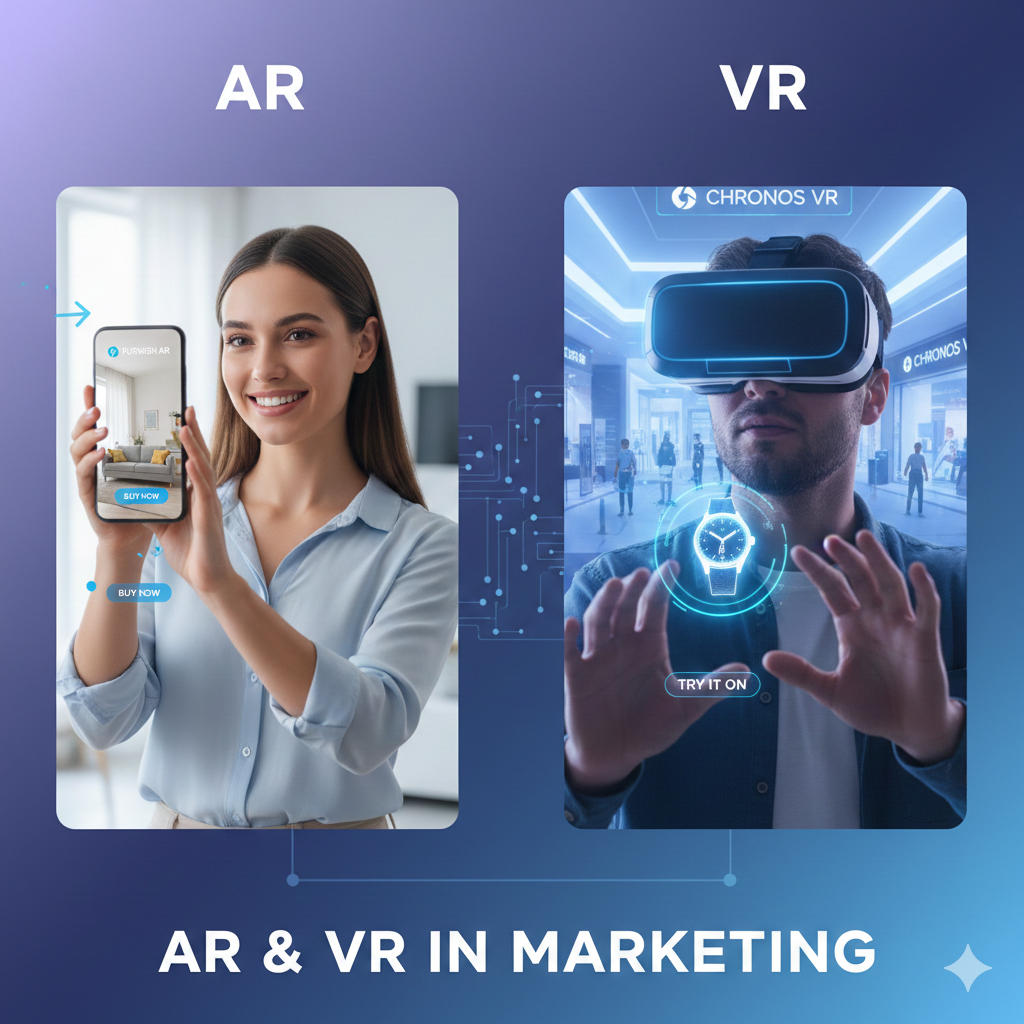
It’s a well known fact that we are living in the world of Digital Marketing and working on projects with future lense. From buying to selling, everything has got on the same platform that is Digitization. Having said that, let’s learn about these two terms in detail AR and VR.
What is Augmented Reality?
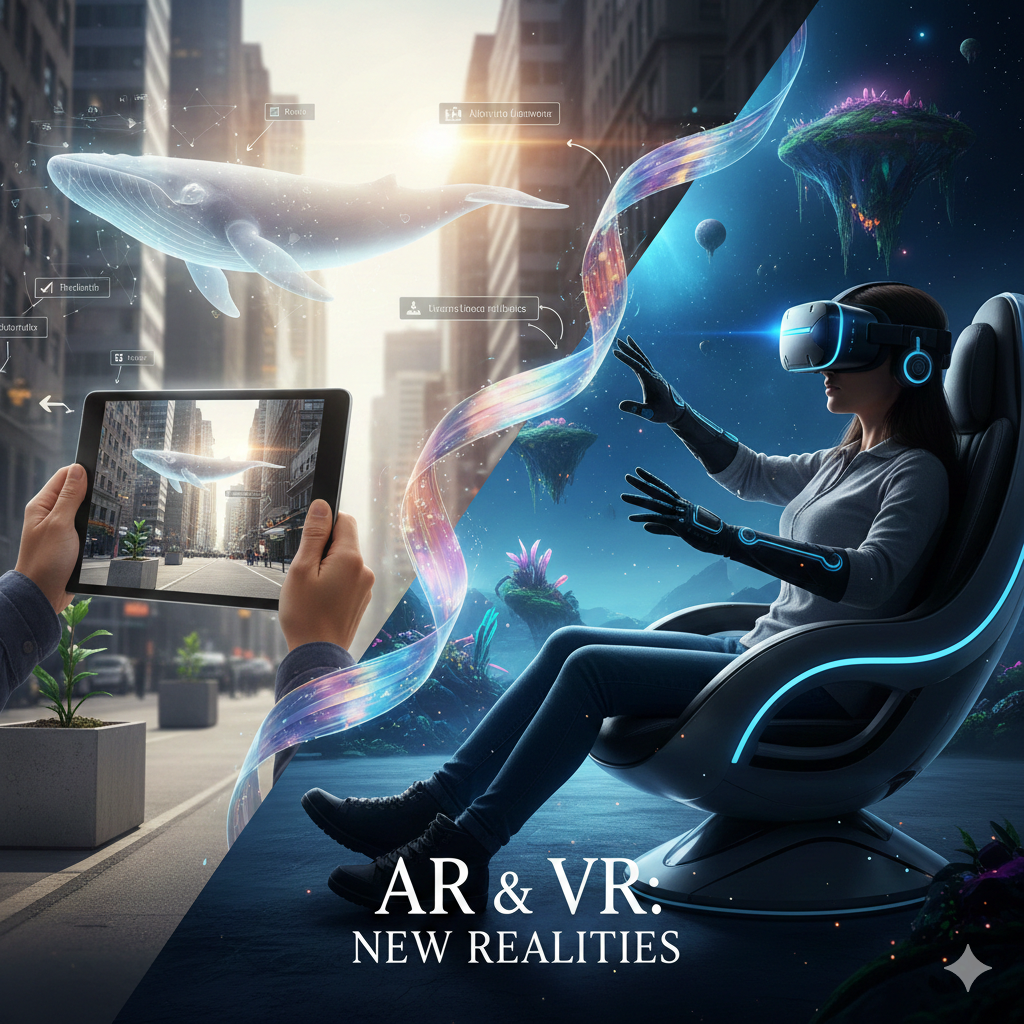
Augmented Reality (AR) is basically a technology that adds digital elements on top of the real world. So when I explain it to someone, I say, “Imagine pointing your phone at a product and seeing its 3D model appear right in your room, that’s AR.” You can still see your surroundings, but with an extra digital layer. It feels like the real and digital worlds are working together. It makes shopping, learning, and exploring much more interactive and easy to understand.
What is Virtual Reality?
Virtual Reality (VR) is completely different, it takes you out of the real world and places you inside a fully digital one. When you wear a VR headset, everything you see is computer-generated, and it feels like you’ve stepped into another world. I usually explain it like this: “You’re standing in your home, but the moment you put on the headset, you’re suddenly on a beach, in space, or inside a game.” VR’s whole purpose is to give you a fully immersive and realistic experience.
Working Of AR and VR
How AR Works?
AR, basically scan your real world using phone cameras and sensors and adjust digital objects in it like from the IKEA app. You can place the sofa of your choice into your room just to check how it will look after purchasing. It is done in process, let’s see step by step.
Step-1- Firstly the phone map’s the environment like floor, walls, objects etc.
Step-2- Then AR apps paste digital objects like 3D objects, text, animations etc into the real world.
Step-3- Now, you see on the phone and it appears like digital objects are placed into the real world.
How VR Works?
VR, unlike AR, blocks the real world and lands you straight into the digital world. Inside the VR headset, it has stereoscopic displays that create different views for both the eyes and you feel depth and reality visually. Here are few steps to actually learn how VR works for you:
Step-1- Wear your VR headset and completely cut off from the real world.
Step-2- Along with the headset, motion tracking sensors come into action and detect your head movements.
Step-3- So when you turn your head (like you do in the real world), the VR world also rotates in that direction.
Why do marketers use AR and VR?
Every maketere wants to give a real and appropriate feel of the product you’re looking for. So just to add value and definition to their products they use VR and AR marketing methods. They also offer interactive and interesting methods of presenting products and brand stories in a saturated digital environment but AR and VR are very useful to draw your attention and make you explore more.
Main advantages of AV and VR:
AV and VR comes with many benefits like improved interactivity, authentic product experience, better conversions, less confusion and so on. Let’s know about them in detail:
1. Improved Interactivity:
Users explore AR/VR products through which engagement and interest increases instantly. This hands-on, playful interaction drives higher dwell time and makes the brand experience more memorable than passive viewing. The immersive nature of the technology transforms a simple product view into an active exploration.
2. Authentic Product Experience:
Customers get buying clarity through virtual try-on or 3D view and experience the real situation of the product. By overlaying a product into a customer’s real environment (AR) or placing them into a realistic virtual showroom (VR), the technology closes the gap between online viewing and physical inspection. This true-to-life visualization minimizes post-purchase disappointment.
3. Better Conversions:
When users get a realistic demo of a product then they decide purchases faster and confidently. The enhanced confidence from knowing exactly what they are getting translates directly into reduced cart abandonment rates. A highly-engaging virtual demonstration serves as a powerful final push towards a successful transaction.
4. Less Confusion:
AR/VR clearly shows the size, fit, colour, and functionality of a product, doubts and returns reduces automatically. This clarity significantly cuts down on costly product returns, as customers’ expectations are accurately set pre-purchase. Consumers can resolve common concerns, such as “Will this sofa fit in my living room?” before placing an order.
5. Emotional Storytelling:
It helps in creating a stronger impact by pressing an emotional and memorable journey of a brand through immersive VR stories. By fully enveloping the user in a 360-degree environment, VR storytelling forges a deep, empathetic connection that standard video cannot achieve. This intense presence helps a brand’s narrative stick with the audience long after the experience is over.
6. Social Sharing:
People share AR filters and VR moments quickly and organic reach of the brand increases. Novel AR experiences, like face filters and world effects, are inherently viral and encourage users to become brand advocates. This user-generated content acts as highly effective, free, and trusted peer-to-peer marketing.
7. Data Collection:
Brands can collect rich data of engagement, behaviour, and preferences by AR/VR interactions. The technology captures granular data on gaze duration, interaction points, and time spent with specific features, providing a deeper understanding of user intent. This advanced behavioral insight is invaluable for optimizing product design and personalizing future marketing efforts.
8. Competitive Differentiation:
By using AR/VR, the brand looks innovative and stands out among competitors in the market. Adopting AR/VR positions the brand as a forward-thinking leader, attracting a digitally-savvy customer base. This early adoption creates a valuable perception of high quality and cutting-edge customer service that is hard for competitors to match.
Reasons Why AR and VR are Revolutionizing modern-day marketing?
With the evolving world, everything is walking towards new things. So does marketing. Many top AI tools for Marketing are available in the market. Change marketing to active experiences, moving past print advertising to experience advertising is one of the live examples for us.
In immersive experiences, the gameplay upon which one engages is fully involved. Here are few reasons penned down for you to learn more about it :
1.Emotional Relationship:
AR/VR create an immersive experience for customers and brands and helps maintain deeper emotional connection.
2.Enriched Product Insight:
Users understand the product in 360° view and in detail through virtual try-outs, which is not possible in normal images.
3.Higher Brand Recall:
Virtual experiences become memorable and customers remember brands for a longer period.
4.Greater Trust:
When customers explore the product virtually, then their doubts get clear and increase trust in the brand.
5.Increased Engagement Rates:
AR/VR involves interactive content users actively due to which engagement rate naturally gets high.
The Concepts of AR and VR: What They Implicate as a Marketer?
Now you know what AR and VR are but the implication as a Marketer is still unknown. Let’s unfold it.
AR and VR are no longer just tech buzzwords but they’ve become powerful marketing tools that reshape how brands communicate, convince, and convert consumers. For a marketer, these technologies represent a shift from telling people about a product to letting them experience it. Here some points which elaborate it:
1. AR Creates Interactive Product Experiences
AR allows you to virtually try or preview products before purchasing. As a marketer, this means you can reduce doubt, increase confidence, and give customers a “try-before-buy” feeling without physical effort.
2. VR Delivers Full Immersion and Emotional Impact
VR transports you into a completely controlled digital world. For marketers, it becomes a tool to create deep emotional connections, memorable experiences, and brand storytelling that feels almost real.
3. Higher Engagement and Brand Recall
Your AR and VR experiences naturally demand attention. Users spend more time interacting with the brand, which leads to stronger recall and a more meaningful brand impression.
4. Reduced Buyer Confusion and Faster Decisions
When you can see, experience, or test something virtually, your hesitation drops. Marketers can shorten your decision-making cycle and improve conversions.
5. Personalized Customer Journeys
Both AR and VR can adapt experiences based on your behavior. This allows marketers to deliver tailored messages, personalized product demos, and context-aware recommendations to you.
6. Strong Differentiation in a Competitive Market
Brands that use AR and VR immediately stand out and you can notice the difference. Marketers can position their brand as modern, innovative, and customer-focused, a big advantage in crowded markets.
7. Data-Driven Improvements
Your AR/VR interactions generate high-quality behavioral data.
Marketers gain insights into what customers view, interact with, or ignore, helping refine campaigns, UX, and product strategy.
AR & VR: Why They Matter More Than Ever to Today’s Digital Consumers?
If you’re trying to understand why AR and VR are suddenly everywhere, from shopping apps to gaming to brand campaigns, it’s because today’s consumers don’t just want information, they want experiences. And that’s exactly what AR and VR deliver.
Here are the key points you should explore, and I’ll explain why each one matters in a simple, conversational way:
1. Consumers Want More Immersive Experiences
If you are the one who is tired of plain images and videos then you are not alone.
Today’s user wants to feel the product, see how it fits into their life, and experience it before buying. AR/VR gives you that depth and realism.
2. Convenience Has Become Non-Negotiable
When you are buying something online you won’t travel to a store just to try something out. With AR, you can check how a sofa looks in your room or how a lipstick shade suits you, all from your phone and from the comfort of your home. It is absolutely convenient, quick, and zero risk.
3. They Trust What They Can See
You, being modern consumers, are more skeptical. We don’t trust marketing claims easily, we want proof. AR and VR act like a live demo, which instantly builds our confidence and reduces doubts.
4. You deserve Personalized, Interactive Journeys
You don’t want one-size-fits-all content. AR/VR experiences adapt to your needs, whether it’s size, color, style, or environment. It feels like the brand understands you.
5. Higher Engagement Means Higher Satisfaction
Let’s be honest, digital attention spans are shrinking.
But AR filters, virtual try-ons, VR brand stories, these hold people’s attention longer. And when you experience it, you remember the brand.
6. Brands are Modern and Innovative
Digital consumers judge brands by their tech-savviness. If a brand uses AR/VR, it automatically feels more premium, updated, and future-ready and it’s a trust signal.
7. Social Sharing Drives Trend Culture
People love sharing cool experiences. AR lenses, virtual tours, VR moments, all these become instant social content. And consumers like interacting with brands that make them feel part of a trend.
8. AR/VR Reduce Fear of Buying Online
Online shopping always has one problem, “What if it doesn’t look the same in real life?”
AR/VR reduces that fear by letting consumers preview products accurately. This leads to more confident purchases.
How Brands Are Using AR & VR in the Real World Marketing?
AR and VR are not just futuristic ideas anymore; brands are using them every single day to attract customers, boost engagement, and create memorable experiences, especially when combined with Neuromarketing For Indian Brands to better understand consumer behavior and emotions. Here are the most important ways AR & VR are being used in marketing today:
1. Virtual Try-Ons (Beauty, Fashion, Accessories)
Brands use AR to let you try products before buying, like lipstick shades, sunglasses, watches, or clothes. This solves the biggest online shopping problem and it increases your confidence and reduces returns.
2. Previewing Products in Real Spaces (Furniture, Home Decor)
AR lets you place a sofa in your living room or check how a lamp looks on your table.
It helps customers imagine the product in their actual environment, which speeds up the buying decision. Brands like IKEA and Pepperfry use this widely.
3. Immersive VR Brand Experiences
VR experiences pull people into a fully digital world created by the brand. Imagine exploring a travel destination, taking a factory tour, or watching a brand story in 360°. It creates emotional impact and strong brand recall.
4. AR Filters & Social Media Campaigns
Brands use AR filters on Instagram, Snapchat, and TikTok to create fun, shareable content. These filters boost engagement, help brands go viral, and encourage user-generated content. It’s one of the easiest and most popular marketing methods used today.
5. Virtual Stores and Showrooms
VR allows customers to “walk through” a store from home. They can explore products, view collections, and interact with displays just like a physical shop. This feels premium and gives brands a futuristic edge.
6. AR Product Tutorials & Guides
AR can show you how to use a product visually like assembling furniture, setting up devices, or learning product features. This improves the experience and builds trust.
7. VR Training & Demonstrations (Cars, Real Estate, Machinery)
Car brands use VR for virtual test drives. Real estate uses VR for virtual apartment tours. Machinery companies use VR for safe training. It helps customers understand big, complex, or expensive products easily.
8. Event & Exhibition Experiences
AR/VR booths at events create excitement, attract crowds, and let people interact with the brand in unique ways.
It’s a strong brand differentiation tactic.
How AR and VR Help Brands Boost Conversions and Reduce Returns?
If you think about how AR and VR helps brands in boosting conversion then you must read it. As we know that AR and VR have become powerful tools for brands because they let you see, test, and understand products before buying something regular online shopping can’t fully offer. When you virtually try clothes, test shades, place furniture in their room, or explore a product in a realistic VR environment, your doubts reduce instantly. This clarity naturally leads to higher conversions because you feel more confident in your choices and tell your connection about such experience.
At the same time, AR and VR significantly lower product returns. Most returns happen due to mismatched expectations like size, color, fit, or the product not looking like the images. But when you preview products in your own environment or on yourself, they know exactly what they’re getting. This accuracy reduces disappointment and cuts down on unnecessary returns, making AR and VR a smart strategy for brands looking to Earn From Digital Marketing.
The Future of AR/VR Marketing
The future of marketing is moving toward experiences where consumers don’t just view content, they live it. AR and VR will reshape how brands showcase products, tell stories, and build emotional connections.
The future of AR and VR in marketing will focus on:
Personalised Product Experiences: Customers will try products virtually like clothes, furniture, décor, before buying, reducing confusion and returns. AR technology lets shoppers check fit and styling immediately. This leads to a significant reduction in product returns.
Immersive Brand Storytelling: Brands will build virtual worlds where customers can explore stories instead of reading them. Consumers enter a 3D virtual environment (metaverse) to experience brand values. Fosters a stronger emotional connection than static ads.
Virtual Stores & Showrooms: Shoppers will enter 3D digital stores, walk around, and interact with products like in real life. Allows 360-degree product detail viewing globally. Makes the flagship experience available 24/7, eliminating barriers.
Stronger Customer Engagement: Interactive AR filters, gamified VR experiences, and virtual events will increase attention and participation. Customers become active participants in virtual fashion shows or product launches. These are socially-shareable experiences that generate organic reach.
Better Decision-Making: Seeing products in real environments (AR) helps customers make quick, confident choices. Instantly verifies if items fit dimensions or work with existing décor. Reduces purchase uncertainty, accelerating the path to checkout.
AI + AR/VR Integration: Future marketing will combine AI insights with immersive tech to deliver personalized recommendations inside virtual environments. AI analyzes shopper movement in the virtual store to understand preferences. Creates a hyper-personalized shopping journey where items are highlighted for the user.
Higher Conversion Rates: Realistic experiences lead to faster purchase decisions and more trust. Clear product understanding reduces cart abandonment. Results in a more efficient marketing funnel with higher confirmed sales.
In Summary: The Importance of Immersive Experiences
Immersive experiences matter because they create deeper, more memorable interactions between consumers and brands. Instead of passive viewing, users actively engage, touching, exploring, and feeling a product or story. This level of involvement increases emotional connection, reduces hesitation, and helps customers make confident decisions. So When Developing Your Website Content, one must focus on correct execution of these tools.
In short, immersion makes marketing more impactful, more personalised, and far more effective in influencing real buying behaviour.
FAQs
Is AR and VR marketing useful for small businesses?
Absolutely yes. Today AR filters, virtual try-ons and 3D previews have become much affordable.
Do marketers need technical skills to use AR and VR?
Not really. Many easy tools are available today that help create AR and VR experiences without coding. Marketers just need a clear idea of how they want users to experience the product or brand.
Is AR and VR marketing only useful for B2C brands?
No. AR and VR also work well for B2B brands. They are used for product demos, virtual tours, and training to explain complex products easily.
How can brands measure the success of AR and VR marketing?
Brands track user engagement, time spent, conversions, and return rates to understand how well AR and VR campaigns perform.
Will AR and VR replace traditional digital advertising?
Not completely. AR and VR will support traditional ads by offering better experiences and helping users make faster decisions.
Tags:
Comments (3)
Digital Marketing Guide: Everything You Must Know
says February 20, 2026 at 5:13 am[…] AR and VR are changing the way we see the product prior to making a purchase. The virtual try-on to the fully-realized brand world are innovations that break down the digital and physical divide. With hardware getting cheap, and content creation tools reaching maturity, AR/VR will allow hyper-realistic demos, backstage tours, and completely interactive shopping experiences, and will usher in a new age of experiential marketing. […]
How to Choose a Digital Marketing Agency in Lucknow?
says February 27, 2026 at 2:06 am[…] to blogs and websites, progressive agencies resort to interactive content, short videos, and even AR and VR in the marketing field, which works well in the real estate, education, and retail markets of Lucknow. Successful […]
HarleyImmal
says March 22, 2026 at 12:13 pmI started writing down one thing at the end of every day — what I actually managed to do. Not a to-do list, not plans. Just one small win. It’s surprising how quickly it shifts your perspective.