


Artificial intelligence is changing the face of marketing, making data actable, and automating repetitive activities. AI enables us to predict consumer behavior, create content based on each customer and tailor it at scale, and real-time optimization of campaigns, in addition to providing the marketer with greater time to work on strategies.
What are the Advantages of AI Tools in Marketing?
The benefits of AI tools in marketing is that it helps the task to be done easily and in a shorter time. Here are few advantages that would help you to know how AI tools in marketing helping global market to evolve.
1. Hyper-personalization -Engage every customer with a personally relevant message that makes their customers more engaged and convert more often.
2. Predictive Analysis- Estimate customer’s lifetime value builds on it. Identifying customer’s risk and forecasting future buying behavior.
3. Fast content production – Rapid design of headlines, body and graphics, reducing time in the production process.
4. Real-time campaign optimization – Optimize bids, budgets and targeting automatically to maximize campaign performance.
5. Better customer segmentation– Spot micro-audiences not gained by the traditional methods thus resulting in more precise targeting.
6. Improved customer service – Implement chatbots which answer questions immediately and gather valuable feedback.
7. Decision making based on data– Turn raw data into actionable data to be used in the strategic process.
8. Cost savings -AINU provides a smarter allocation of resources, and reduces manual work and lowers acquisition costs.
9. Scalable reach: It reaches millions of prospects all simultaneously and still makes the message relevant.
Top AI tools for Marketing

Messaging and prioritising prospects through AI based predictive lead scoring and content optimisation. CRM data is processed through integrated CRM which automates nurturing workflows, and increases the rate of conversion.
2. Marketo (Adobe) –
Dynamic segmentation, personalised email journeys and ROI attribution all rely on machine learning. Its predictive intelligence engine based on artificial intelligence previews customer behaviour and offers the most suitable touchpoints.
3. Crimson Hexagon (brandwatch now)
The hexa analyzes billions of posts per second on social media using natural-language processing to deliver brand sentiment, trend and influencer outreach. Agile adjustments in the campaigns take place in real-time dashboards.
4. Persado
Language copy that resonates with emotions is generated by language models with deep-learning that explore thousands of word combinations. This increases both click-through and conversion rates by having different tones and Frameworks based on audience segmentation.
Canva Magic write is an AI-powered design assistant that generates copy and composes layouts and proposes imagery to the Canva visual editor. It accelerates the process of asset generation to social, email and ad campaigns without implying brand inconsistency.
6. Cortex
Visual AI platform is used to predict the best creative assets that can perform well in different channels. It does this by drawing upon past data to make suggestions on design adjustments that will maximise interaction and ROI.
7. Adext AI –
An AI tool that optimises campaigns automatically through Google, facebook and LinkedIn. It understands what bids and variations of ad lower the cost per acquisition and leave marketers to concentrate on strategy.
ChatGPT writes emails, ad scripts, blog outlines and chatbot scripts through GPT-4. Prompts that can be customized enable teams to produce high-quality content with thousands of prompts that are brand-aligned.
Top AI tools for Content Creation-
1- ChatGPT
ChatGPT is a multi-purpose chat-based AI. It has the ability to write blog posts, product descriptions and social media copy in a natural, context-sensitive language. The model can be done through quick cycles and can be varied in the tone, length, and style to suit any company specifications.
2- Claude
Anthropic came up with Claude, which generates clear and concise information. It is more safety-conscious and less prejudiced. Claude may be used to brainstorm, polish drafts or generate technical articles, which writers use to write.
3- Jasper
Previously Jarvis, Jasper specialized in selling copy. It provides advertisement templates, email templates and landing page templates. The AI can imitate your brand voice, and propose key phrase-filled words to get more interactions and contacts.
4- Copy.ai
Copy.iant is a company that focuses on fast idea generation. It offers headline and product description as well as social media post tools. Its easy interface also allows one to create creative variations with minimal input.
5- Rytr
Rytr generates AI content in numerous languages and tones. It is perfect in multilingual copy required teams. Rytr accepts blog outline to short captions formats, and allows you to change length.
6- Canva AI
Canva AI tools, including Magic Write and design recommendations, allow one to write on a visual and paste images and text. They automatize the production of content, by automatically creating design layouts, copy and short video scripts.
7- Runway ML
Runway ML offers video and image editing AI. It has features such as background removal and style transfer which make creators able to create finished multimedia in a very short time. The ability to drag and drop provides easy advanced editing to non-technological users.
8- Surfer SEO
The Surfer SEO utilizes the search engine information in determining how the content should be structured and what keywords to use. It assists in ranking of articles. The platform also provides real-time advice in the word count, headings, semantic relevance to improve the optimization of the search engine.
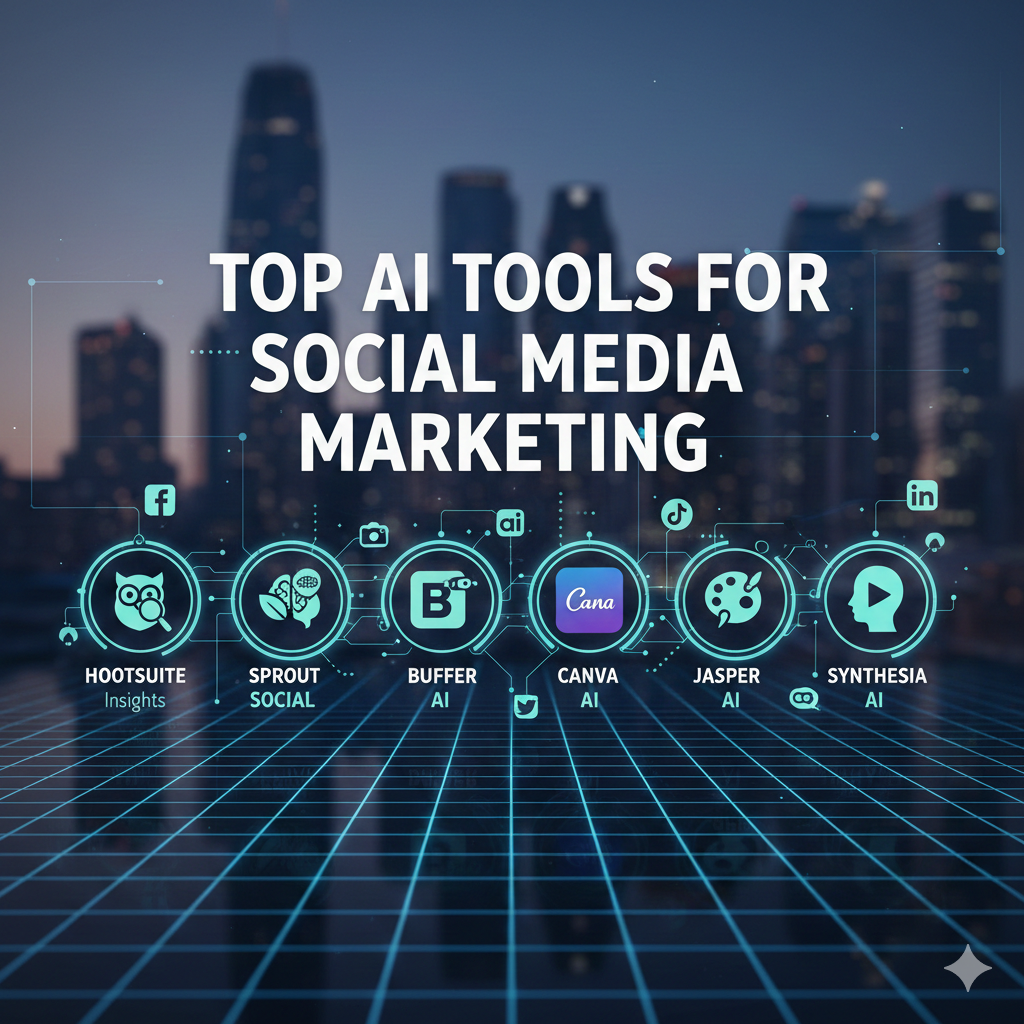
Top AI tools for Social Media Marketing
1- FeedHive
FeedHive is an automation tool designed specifically to operate in the social-media sector and which allows a business to schedule, publish and analyze content on a variety of networks with a unified dashboard. It also provides AI-powered content recommendations and real-time performance analytics to enable teams to make the most out of their posting strategy.
2- Buffer
Buffer has a simple and easy-to-use interface regarding scheduling posts, monitoring interactions, and teamwork. The clear metrics of reach, clicks, and audience growth provided by its analytics tools can allow you to filter your content calendar with ease.
3- Flick
Flick is a videos-based social media platform to facilitate creation, editing and sharing of any short-form videos on Tik Tok and instagram reels. It combines AI-enabled editing templates and performance monitoring to assist creators to gain as many views as possible.
4- Predis.ai
Predis.ai is an AI-written generation tool, which creates social media text, captions, and hashtags in your brand tone. It also has performance analytics and scheduling, which enables the marketer to test and fast-test faster on what their audiences react to.
Canva Magic Studio is an add-on to Canva’s popular graphic-designer platform that integrates AI design features and can create images, layouts, and visual content on the basis of simple prompts. It is especially suitable when the marketer requires high-quality visuals easily without having to employ a designer.
6- Hootsuite
Hootsuite is a social-media management system that brings together the activity of publishing, monitoring and collaboration with dozens of networks. Its powerful reporting capability and advanced schedule support make it one among the preferred ones by marketing departments, which is of an enterprise level.
ContentStudio is a single platform where content can be discovered, created, and distributed, as well as provide AI-driven insights into what is trending and what the audience will be interested in. The analytics dashboard in the tool assists teams in calculating ROI and making on-the-fly changes.
8- CapCut
CapCut is a free, mobile-first video editor, which is user-friendly and provides social-media video editing with cutting, transition, and effects. It automatically creates subtitles and recommends music, allowing creators to create refined clips in a short time on Instagram, Tik Tok, and others.
Top AI tools for SEO
1- Semrush
Semrush is a one-stop solution that provides all the information on keyboards, site audit, backlink monitoring and competitive intelligence. It assists marketers to streamline SEO, PPC, content, and social media tactics through the provision of data-heavy dashboards and actionable data.
2- Surfer SEO
Surfer SEO is a content optimization tool that examines high-ranking pages in a target keyword. Adhering to these real-time recommendations, authors can develop the article that meets search intent and has more chances to appear on high positions of SERP.
3- Clearscope –
Clearscope is an SEO content editor with information about the keywords, readability rating, and a comparison with competitors. Its user-friendly interface allows teams to match content and user intent, increasing their visibility and interaction.
4- Frase –
Frase is an artificial intelligence-based research assistant that researches search results, creating topic summaries, answering key questions, and proposing headings. It allows teams to create end-to-end, search-optimized content in a short time.
5- Alli AI
Alli AI is a content-writing assistant that writes, edits and formats marketing copy such as emails, blog posts, and advertisement copy and adds keyword recommendations that align with SEO. It maintains the brand voice and relevancy and it leaves the writers to think strategically.
Search Atlas is a platform enabling key-word research and competitive intelligence mapping across keyword clusters, volume of searches and difficulty. It assists marketers to identify untapped opportunities in the market.
7- MarketMuse
MarketMuse is a content planner based on AI that conducts an audit and finds coverage gaps, as well as suggests clusters of keywords and depth of coverage.
Keyword Insights combines the search volume, search trends and competition data on various search engines. The readily readable reports in the platform assist the teams in making decisions on which terms to focus on in achieving high ROI.
Top AI tools for Email Marketing
1- ActiveCampaign –
It is a cloud-based marketing automation platform that combines email, CRM and sales automation. It develops custom customer experiences in a small number of settings.
2- Klaviyo –
Email and SMS e-commerce specific mail and message dispatcher. It applies data to target users and offers products to them. This increases the conversion rates.
3- GetResponse –
All-inclusive email marketing software. It provides reactive templates, automation processes, home pages, and webinars. Best suited to the small to midsize marketer.
4- Omnisend –
A multichannel e-commerce service. It integrates e-mail, SMS and push notifications. Robots and product-based segmentations boost their participation and purchase.
5- Jasper
It writes persuasive email copy, email subject lines and entire campaigns at the prompt. The marketers are saving time and maintaining their brand voice.
6- Hoppy Copy –
A creative copy tool. It relies on AI to create catchy headlines, descriptions of products, and emails snippets. A single click produces interactive content.
7- Seventh Sense –
The predictive email-delivery engine. It studies the behavior of the inbox to schedule the messages in a way that they will get the highest open rates. Emails fall on the recipient at a time that an individual is likely to open.
8- Mailchimp–
A well-known emailing marketing platform. It provides the drag and drop design, audience segmentation and analytics. Integrations make it an all-purpose communication center.
Top AI tools for Advertising
AdCreative.ai is a machine-learning company that creates high performing ad creatives on Facebook, Instagram, and Google. Through the optimization of thousands of successful adverts, it develops potent visuals and copy that can be tailored to a particular campaign within a short time.
2. Albert AI
The proposed system is Albert AI as an IT-based autonomous AI platform that allows planning campaigns, executing them, and optimizing campaigns in real-time. It is perpetually experimenting with creatives, viewers and channels, changing bids and directives to increase ROI on the automated front.
3. Creatify.ai
Creatify.ai is an autonomous creativity instrument, which converts ordinary text into video, image, and copy contents. Its visual merchandise allows marketers to create eye-catching brand-consistent content on scale with its drag-and-drop interface.
HubSpot Campaign Assistant is artificially intelligent that enables marketers to design, schedule, and measure email, social, and landing campaigns. It recommends the content enhancement, anticipates the results and monitors the essential metrics to ensure an on-course campaign.
5- Jasper AI
Jasper AI (previously Jarvis) is a content creation platform that will write you a blog post, advertisement copy, and email sequences, among others. Its tone-modulation tools and natural facilities in languages assist marketers to create brand-stable copy in a brief period.
6- ChatGPT
ChatGPT, which runs on the GPT-4 of OpenAI, writes copy, brainstormed how to do a campaign, answered questions posed by customers, and wrote scripts. It is a comfortable talking interface and can serve as an assistant in any advertising activity that needs speed and responsiveness to context.
7- Zapier
Zapier is a software to automate the process of connecting ad tech applications, CRMs, email systems and analytics software. With the development of Zaps, marketers no longer have to write code, as they can cause actions, such as sending fresh leads to an email list, quickly.
8- Canva AI
Canva recommendations on layouts, color schemes, and text is immeasurable. Users can create complete posts on social networks or presentation slides with the smallest amount of effort, which guarantees the same aesthetics of the brand in each channel.
Top AI tools For Customer Support.
1- Intercom –
Triage inquiries, provide instant answers, and route tickets to human agents to provide proactive support using chatbots and automated workflows.
2- Zendesk AI –
Uses natural-language understanding to propose solution recommendations out of knowledge bases, create responses to tickets, and finds insights that assist agents in solving problems at a faster and more reliable rate.
3- Freshdesk –
It offers AI ticket routing, intelligent responses, and sentiment analysis so that the agents can neglect the complex requests as the software processes the routine tasks.
4- Tidio –
It integrates live chat with chatbots, where they answer frequently asked questions, gather leads, and make conversations with the appropriate department through AI-enhanced conversation flows.
5- Drift –
It uses conversational AI bots to screen leads in real-time, book meetings, and provide immediate responses, and transfers the conversation to a sales representative when it requires more follow up.
6- Ada
It is a full chatbot platform, which learns during the interactions to provide the answers to the users, auto-generate tickets, and is connected to the CRM systems to provide a fully autonomous support experience.
7- LiveChat AI –
AI addition to live chat, which adds AI-generated responses and sentiment scores to the live chat, allows agents to respond in real time as the system picks up new interactions.
8- https://www.helpscout.com/Help Scout –
It is an AI application that auto-populates proposed suggestions, prioritizes tickets, and discovers articles in the knowledge base, simplifying the working process of the support team and improving agent performance.
Top AI tools for Analytics and Reporting
It Utilizes machine-weakening to bring about predictive measurements. It can effortlessly create insights in a natural language that can support brand managers in understanding traffic and conversion patterns.
2- Looker
It is an embedded AI approach that suggests data models, suggests visualizations, and provides explanations in natural language, allowing analysts with little technical effort to explore data.
3- Tableau.AI –
Introduces AI-based capabilities including Explain Data and Ask Data, which detect styles and recommend relationships, as well as allow humans to interrogate data using plain-English queries.
Live views built-in to power BI supports the use of Azure Cognitive Services as well as AutoML in creating a rapid insight, producing predictive models, and enabling users to provide natural language queries with visual responses instantly.
5- Mixpanel
It utilizes machine learning to provide product teams with insight into user engagement and retention based on data. Cohort and funnel optimization as well as predictive scoring
6- Amplitude –
Uses behavioral analytics and AI to surface critical sources of growth, anticipate churn, and make individualized product experiences, basing them on user behaviors.
7- DataRobot –
DataRobot is an extended automation of end-to-end model creation, including cleaning, deployment and enables analysts to produce more powerful predictive models without writing code, and visualize the results with an easy-to-use interface.
8- Domo –
It has AI-powered data discovery, automated dashboard advising and chat querying using natural language and enables complex business intelligence to be accessible to non-technical stakeholders.
Brands that incorporate AI into their marketing environments gain access to accuracy, speed and scale which have previously been viewed as unattainable. The outcome is a more effective working process, greater returns to the investment, and a better understanding of customers. Marketers who embrace AI technology early enough will be the ones that determine the consumer experiences in the future.
FAQs
1. How AI tools helps in marketing?
AI tools in marketing are software platforms that use artificial intelligence to automate tasks like content creation, email campaigns, customer support, analytics, and ad optimization to improve results and save time.
2. How do AI tools help in digital marketing?
AI tools analyze customer behavior, personalize communication, predict trends, automate repetitive tasks, and improve decision-making to increase engagement and conversion.
3. Are AI tools expensive for small businesses?
Not necessarily. Many AI marketing tools offer free plans, low-cost subscriptions, and pay-as-you-go models that are suitable for startups and small businesses.
4. Can AI completely replace human marketers?
No. AI is designed to support marketers not to replace them. Human creativity, strategy, and emotional understanding are still essential for successful marketing.
5. What type of marketing tasks can AI automate?
AI can automate social media posting, email campaigns, customer support, SEO optimization, ad targeting, analytics, content research, and personalization.
6. Is it safe to use AI tools in marketing?
Yes, most AI tools follow strong security and data privacy protocols. However, it’s important to choose trusted platforms and read their privacy policies carefully.
Recent Blogs
Tags:
Comments (3)
AR and VR in Marketing: Immersive Strategies to Boost Engagement
says December 25, 2025 at 11:49 am[…] the evolving world, everything is walking towards new things. So does marketing. Many top AI tools for Marketing are available in the market. Change marketing to active experiences, moving past print advertising […]
How to Choose a Digital Marketing Agency in Lucknow?
says February 24, 2026 at 7:22 am[…] identify the correct audience, monitor conversions, and keep optimizing with the help of the AI-based tool of bidding and targeting, and this is how artificial intelligence will transform performance […]
How to Choose a Digital Marketing Agency in Kanpur?
says March 05, 2026 at 6:56 am[…] agencies also stay updated with changes in search engine algorithms, E-E-A-T ranking factors, AI tools for marketing , and new digital technologies. Most business owners do not have the time to track these updates. […]